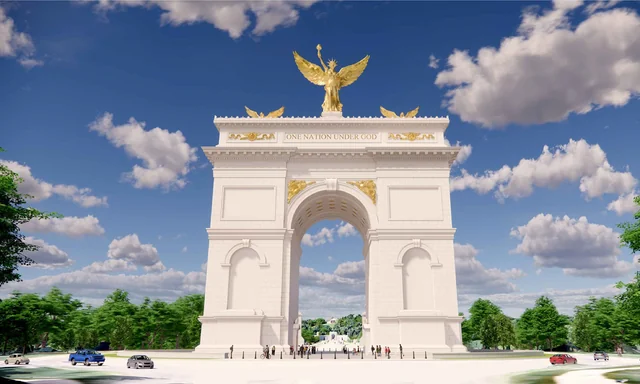
A federal judge in the United States has temporarily halted construction of President Donald Trump’s proposed triumphal arch in Washington, delivering a significant legal setback to one of his most ambitious projects to reshape the American capital. The decision prevents construction work from beginning for 14 days and comes just hours after a federal planning commission approved the controversial 250-foot monument despite strong opposition from local representatives, veterans and members of the public.
US District Judge Tanya Chutkan issued the temporary restraining order in the early hours of Friday following legal challenges seeking to prevent the administration from proceeding with the project. The ruling represents an important development in an increasingly contentious dispute over presidential authority, public land, national monuments and the use of government resources.
The proposed structure, which would stand approximately 76 metres high, has become a major feature of Trump’s plans to leave a lasting architectural mark on Washington. The president has repeatedly expressed admiration for monumental arches in major international cities, including Paris, Rome and London, and has argued that the United States should have an equally impressive landmark.

However, the proposal has generated considerable controversy over its purpose, cost, legal authority and location. Critics argue that the structure could undermine the historical and commemorative character of the surrounding area, particularly because of its proximity to Arlington National Cemetery, where hundreds of thousands of American military personnel and veterans are buried.
The judge’s intervention came after the National Capital Planning Commission voted eight to four on Thursday to approve the project. The decision followed a lengthy hearing lasting approximately nine and a half hours, during which dozens of participants raised objections and questioned whether the administration had satisfied the necessary legal and planning requirements.
The administration had indicated that construction could begin shortly after the commission’s approval, provided the Interior Department issued its final authorisation and the required notification was published by the National Park Service. However, the temporary restraining order has prevented the government from immediately moving forward.
Judge Chutkan granted a request from the latest plaintiffs challenging the project and also consolidated several related legal cases. These include lawsuits brought by the District of Columbia and Virginia, alongside a case involving a group of Vietnam veterans and an architectural historian.
The combined legal challenges are expected to examine whether the administration followed the appropriate procedures and possessed the necessary authority to approve construction of a monument of this scale. Questions about congressional approval, funding arrangements and the use of federal land are likely to remain central to the dispute.
One of the biggest unresolved issues concerns the project’s financial cost. The administration has not provided a clear final figure or explained precisely how the construction would be funded. Some estimates have placed the potential cost as high as $100 million, raising concerns about public expenditure and financial accountability.
The absence of a clearly established funding plan has intensified criticism from opponents who argue that a project of this scale should not proceed without greater transparency. They have also questioned whether public resources should be committed to a new monument while other national priorities require attention.
Thursday’s planning commission hearing exposed deep divisions between representatives connected to the federal administration and officials representing local interests in Washington. The vote largely followed federal and local political lines, with members supporting the administration’s proposal on one side and representatives of the city opposing it on the other.
Mark Paoletta, the commission’s Trump-appointed chairman, strongly defended the proposed monument at the beginning of the hearing. He argued that major monuments play an important role in expressing national identity and praised Trump for pursuing a project intended to create a prominent landmark for the country.
Paoletta also referred to famous arches in European capitals, suggesting that Washington should have a comparable structure reflecting American history and national identity. His comments reflected the administration’s broader argument that the monument could become an internationally recognised symbol of the United States.
Commissioner Paul Ingrassia, a lawyer associated with the General Services Administration, also defended the proposal. He argued that the structure should not be viewed primarily through a political lens but as a tribute to national history and military veterans.
According to Ingrassia, the project was intended to commemorate service members and provide a landmark around which Americans could unite. Supporters have therefore attempted to present the arch as a national memorial rather than simply a personal architectural initiative of the president.
However, opponents challenged that interpretation and questioned whether the project had received the necessary institutional approvals. Washington DC city council member Phil Mendelson, who also serves on the planning commission, argued that Congress had not approved the project and had not appropriated funds for its construction.
Mendelson further questioned the documentation submitted to the commission. He said the plans did not contain sufficient information to justify final approval and pointed out that the military-related purpose highlighted by Trump and other administration officials was not adequately reflected in the submitted proposal.
His objections raised broader concerns about the planning process and whether the commission could lawfully approve a project without receiving complete site and building plans.
The controversy also attracted criticism from Democratic lawmakers in Congress. Representative Jared Huffman of California, who is expected to chair the House Natural Resources Committee, described the proposed arch as an ill-advised and potentially illegal project.
Huffman argued that the structure would not genuinely honour American military personnel but would instead serve as a monument to Trump himself. He compared the proposed design to grand structures historically associated with emperors and kings, questioning whether such a project was appropriate in a democratic republic.
He also accused the administration of using the reputation and sacrifice of American veterans as justification for a monument that critics believe is intended to strengthen the president’s personal political legacy.
The proposed location has become another major source of disagreement. The arch would be constructed on a section of grass near the bridge spanning the Potomac River, which connects Washington with Arlington National Cemetery.
The cemetery is among America’s most important military burial grounds and contains the graves of generations of service members who died in wars and military operations. Opponents fear that introducing a towering architectural structure nearby could interfere with the solemn atmosphere of the memorial landscape.
During the public hearing, veterans and other participants expressed strong objections to the proposal. Many argued that the area should remain focused on remembrance, sacrifice and respect for those who served the country rather than becoming the setting for a politically controversial construction project.
The hearing itself was marked by technical difficulties. The remote call-in system repeatedly crashed during the early hours, while the online comment section reflected widespread opposition to the proposal. Dozens of people continued waiting to speak even after several hours of discussion.
The strength of public opposition demonstrated that the project has become more than an architectural planning dispute. It has developed into a broader debate about how national history should be represented, who has the authority to approve major monuments and whether presidential initiatives should be subject to stronger institutional oversight.
Trump’s proposed arch is also part of a wider series of projects through which he has sought to transform Washington’s appearance. His administration has pursued renovations involving public spaces and recreational facilities, while his plans concerning the John F Kennedy Center for the Performing Arts have also generated controversy.
The latest developments come at a particularly sensitive political moment following the Democrats’ significant victories in the 2026 midterm elections and their expanded control of Congress. The new political balance could bring closer scrutiny of federal construction projects, administrative decisions and the use of public resources.
Democratic lawmakers are expected to exercise greater oversight over executive agencies, potentially making it more difficult for the administration to advance controversial projects without detailed explanations and institutional approval.
The temporary restraining order does not necessarily mean the arch has been permanently cancelled. Instead, it provides a short period during which the legal challenges can proceed and the court can consider whether construction should remain suspended.
The administration may seek to defend its approval process and demonstrate that the project complies with applicable laws and planning requirements. Meanwhile, opponents are likely to continue pressing their arguments concerning congressional authority, funding and the protection of historically significant public spaces.

The case could therefore have implications extending beyond the proposed monument itself. Its outcome may help clarify the limits of presidential authority over major construction projects in the nation’s capital, particularly when those projects involve federal land, public funding and nationally significant locations.
For now, the future of Trump’s triumphal arch remains uncertain. The proposed structure has received an important planning approval, but the federal court’s intervention has prevented the administration from immediately beginning construction.
As the legal proceedings continue, the dispute is likely to remain a prominent issue in Washington’s political and public debate. At its centre is a fundamental question about national identity and public responsibility: whether a major monument should reflect the collective history and sacrifices of the American people or become closely associated with the political ambitions of an individual president.
Related News:
 Trump’s Revenge Drive Deepens GOP Divide
 Latin America women fear rollback of rights
 Trump Attacks Norway After Nobel Peace Prize Snub
 Ten US Midterm Races That Could Defy Expectations
 Ohio Airports Become Key Hubs for ICE Deportation Flights
 Brazil Cuts Working Week to 40 Hours in Lula Election Boost
 Talarico Faces Tough Voter Test in Texas Senate Race
 Obama Warns Against Threat to Ilhan Omar’s Citizenship
 US Midterms Could Reshape Trump’s Second Term
 Trump’s Midterm Campaign Faces Racism and Political Backlash
 Thousands Protest ICE Operations in Nationwide US Day of Action
 US Court Weighs Fate of TPS for Migrants
 US Court Ruling Reshapes Voting Rights Landscape
 US states redraw maps after voting rights ruling
 Judge halts deportation of Yemeni refugees in US
 Trump warns Iran as Middle East tensions surge again
 Immigration Judges Fear Pressure in Trump Era
 Former ICC prosecutor condemns US sanctions
 Gunman Killed After White House Security Shootout
 Le Pen’s Popularity Holds Despite Conviction
 Trump Orders Signs Criticising Smithsonian Museum
 Is America Ready for an AOC Presidential Run?
 US Networks Suspend Trump White House Pool Coverage
 Trump and Mamdani Hold Cordial Gracie Mansion Meeting
 Democrat Says ICE Restricted Detention Camp Oversight
 King Refers Jamaica Slavery Petition to Privy Council
 Republican Senator Questions Trump Ad Spending
 French Student Protests Escalate Into Violent Clashes
 Burnham Opens Door to Possible UK Return to EU
 Drumcree Talks Falter as Legal Challenge Deepens
 UK-France Returns Deal Faces Expiry as Talks Stall
 Trump Immigration Policy Faces New Legal Tests
 French School Protests Escalate as 400 Schools Close
 Families Await USS Abraham Lincoln Homecoming
 Trump Rally Faces Protests as Texas Race Tightens
 Tanker Attacked Near Qatar as Hormuz Tensions Escalate
 Botstein Quits Bard Amid Epstein Investigation Calls
 Trump Says He Deserves Nobel Peace Prize
 USS Lincoln Ends Record 265-Day Deployment
 US Senate Debates Turn Bitter as Midterms Near
 Bolsonaro Gains Key Endorsement Ahead of Brazil Runoff
 US Execution Livestream Plan Sparks Global Outrage
 Controversial Vaccine Trial Approved in Guinea-Bissau
 Delhi Detains Protest Leaders as Youth Rally Escalates
 Trump Names Katie Zachariah as Next White House Press Secretary
 Brazil Court Scandal Threatens Lula as Bolsonaros Rise
 Millions Face Tougher Medicaid Rules From January
 Farage Rejects Claims Reform Would Let Troops Shoot Migrants
 Judge Blocks Trump White House Media Ban
 Trump Warns Alaska Voters Over Rival Dan Sullivans
 Trump Targets Arizona and Montana Amid GOP Election Worries
 Gadi Eisenkot: Israel’s Anti-Netanyahu Challenger
 Trump Rallies GOP as Senate Democrats Boost Key Races
 Trump’s Ambassador Picks Face Growing Controversy
 Serbia Leader Linked to Controversial Trump Tower Plan
 Trump Slams Ukraine Strikes as Russia Ceasefire Collapses
 Trump Falsely Questions Ossoff’s Election Legitimacy
 Macron Condemns Violence as France Faces 2,400 Arrests
 Suu Kyi Appears in Rare Photos After Royal Gift
 Zelenskyy Accuses US of Delaying Ukraine Missile Supplies
 Fifth Foreign Firm Withdraws From Jerusalem Cable Car Plan
 Meta Faces Election Bias Claims Ahead of Brazil Runoff
 Omar Claims US Raid on Residence Was Meant to Intimidate
 Milan Braces for Unrest as Debate Intensifies Over Lost Generation
 Greens Face Leadership Test as Jordon Steele-John Misconduct Claims Leave Party in Limbo
 Lula Supporters Make Final Push Ahead of Brazil Runoff
 Rubio Urges Cubans to Seize Moment for Change
 Vance Steps Up Midterm Role Amid 2028 Questions
 Serbia’s Student Victory Sparks a ‘Smell of Freedom’
 Flávio Bolsonaro Reportedly Leaves Brazil After Election Defeat
 Obama Mocks Trump at Georgia Rally for Democrats
 King Charles Faces Reparations Protests at Antigua Summit
 Global Crises Test Diplomacy as Trump’s Policies Face Scrutiny
 Bedouin Women Drive Historic Arab Election Gains
 US Judge Blocks Pressure on Election Officials
 US Midterms Put Trump’s Presidency to the Test
 Hegseth Faces Growing Pressure After GOP Election Defeat
 Trump-Backed Republicans Suffer Major Midterm Defeats
 Hanson Takes Racial Discrimination Case to High Court
 Democrats Expand House Majority in Major Midterm Victory