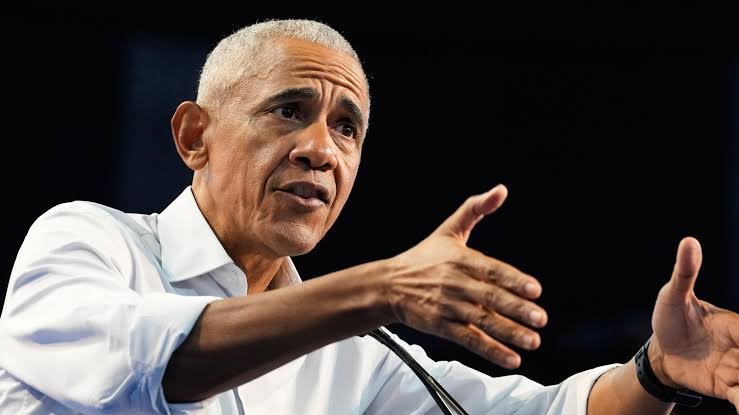
Former US president Barack Obama has launched a sharp political attack on Donald Trump and the Republican Party, accusing them of failing to take their responsibilities seriously as he rallied support for Democratic candidates in Georgia ahead of the 2026 midterm elections. Speaking to thousands of supporters in suburban Atlanta, Obama criticised the president’s priorities, raised concerns about the cost of living and alleged corruption, and urged voters to consider the broader consequences of Republican leadership.
Obama’s appearance on Wednesday came during the final week of campaigning before the midterm elections, when control of Congress and several important state offices is at stake. The former president travelled to Georgia to support Democratic Senator Jon Ossoff, former Atlanta mayor Keisha Lance Bottoms, who is running for governor, and other Democratic candidates seeking election to state and federal offices.
The rally at the Discovery Center in Clayton County, just south of Atlanta, drew an estimated 3,500 to 4,000 people. The gathering reflected the importance Democrats have attached to Georgia, a politically competitive state where election outcomes can influence the balance of power in Washington and shape the direction of state government.

Obama has become increasingly direct in his criticism of Trump and Republican candidates during his campaign appearances across the country. His latest remarks combined humour with broader arguments about presidential conduct, economic pressures and the use of political power. Rather than concentrating exclusively on individual candidates, he sought to present the election as a choice about leadership, accountability and the responsibilities of public office.
One of the rally’s most memorable moments came when Obama revisited a joke he had made about Trump’s expensive renovations at the White House. The former president had previously compared the president’s decorative ambitions to those of Saddam Hussein, the former Iraqi leader, while referring to a Cheesecake Factory restaurant. Trump’s reaction to the comparison became a fresh target for Obama’s criticism.
Obama told the crowd that the comparison involving Saddam Hussein had apparently caused less concern than the reference to the restaurant. He then mocked what he described as the administration’s extensive response to the joke, suggesting that government officials had devoted an extraordinary amount of attention to a minor political insult.
According to Obama, the White House had even contacted the Treasury secretary and suggested that he hold a press conference outside a Cheesecake Factory. Obama used the anecdote to argue that senior officials should be concentrating on pressing economic challenges, particularly inflation and the financial difficulties confronting American households.
The former president also rejected accusations that his reference to the restaurant reflected snobbery or disdain for ordinary Americans. He joked that, as the father of two daughters, he could hardly have avoided visiting the popular restaurant chain while raising his family.
The humour helped energise the audience, but Obama quickly connected the exchange to a more serious argument about the presidency and economic fairness. He accused Trump of prioritising personal financial interests and selling political favours while in office, alleging that the president had accumulated billions of dollars during his time in power.
Obama argued that such conduct represented a departure from the standards expected of the country’s highest elected office. His comments reflected a broader Democratic campaign message that economic pressures facing ordinary households should be considered alongside questions about transparency, conflicts of interest and presidential accountability.
The construction of a new ballroom on the site of the former East Wing of the White House also featured prominently in the rally. Democratic speakers used the project as a symbol of what they described as the administration’s misplaced priorities at a time when many Americans are concerned about living costs and access to essential services.
Ossoff, who is seeking re-election to the Senate, delivered a similarly forceful criticism of Trump. He accused the president of leading an administration marked by corruption and argued that the consequences of the current political climate would eventually become a matter of public accountability.
The senator referred to the possibility of Democrats regaining control of Congress in the following year and their stated intention to pursue impeachment proceedings against Trump if they secure sufficient political power. Addressing the crowd, Ossoff suggested that individuals involved in alleged wrongdoing could eventually be required to testify under oath.
His remarks prompted chants of “Lock him up!” from supporters, illustrating the intensity of opposition to the president among those attending the event. The exchange also demonstrated how questions about potential investigations and congressional oversight have become prominent features of the Democratic campaign.
However, any future impeachment effort would depend on the election results, the composition of Congress and subsequent political and legal developments. The rally’s statements reflected campaign positions rather than a determination of wrongdoing by a court.
Bottoms, meanwhile, focused on her campaign to become Georgia’s governor. She contrasted her candidacy with that of Republican opponent Rick Jackson, a billionaire healthcare executive, arguing that both Jackson and Trump represented wealthy political figures whose interests were disconnected from those of ordinary taxpayers.
She accused the two men of seeking to increase their wealth at the public’s expense, making economic fairness and political accountability central themes of her appeal to voters. Bottoms also invoked the legacies of civil rights leader John Lewis and Coretta Scott King, presenting her candidacy as part of a wider movement rooted in political participation and social progress.
“They may have the money, but they will never overtake our movement,” Bottoms told supporters, according to the rally account. Her message sought to mobilise voters who believe that community organising and civic engagement can counterbalance the influence of wealthy political donors.
The gubernatorial race has attracted particular attention because of its potential implications for Georgia’s political balance. Polling cited in the report showed Bottoms statistically tied with Jackson, making the contest considerably less predictable than the Senate race.
Ossoff, by contrast, was reported to hold an eight- to ten-point lead over his Republican opponent, US Representative Mike Collins. Although polling can change during the final days of a campaign and does not guarantee an election outcome, the figures suggested that Democrats viewed the Senate contest as an important opportunity to strengthen their position.
If Bottoms wins the governorship, Democrats could also challenge the Republican Party’s long-standing control of Georgia’s state government. Republicans have controlled both chambers of the state legislature and the governor’s office since 2004, creating what is commonly described as a Republican trifecta.
The race therefore carries significance beyond the candidates themselves. A change in the governor’s office could affect policy debates over healthcare, taxation, public spending and other issues, although the extent of any changes would depend on the composition of the legislature and the political negotiations that followed the election.
Georgia Senator Raphael Warnock also addressed the rally, warning that reductions to Medicaid and the Supplemental Nutrition Assistance Program, commonly known as SNAP, could have serious consequences for vulnerable families and children.
Warnock framed the election as a question of national character and social responsibility. He argued that the country’s political direction should be judged partly by how it treats people facing economic hardship and whether public institutions continue to provide support to those who need it.
His comments broadened the rally’s focus beyond presidential conduct and campaign rhetoric, highlighting the potential consequences of federal policy decisions for healthcare access and food assistance. For many voters, such programmes are closely connected to household budgets and the ability to meet basic needs.
Trump was campaigning in Ohio at the same time as the Georgia event, continuing his own series of rallies in the final days before the midterms. The president has held near-daily campaign appearances as Republicans seek to defend their candidates and maintain political influence in Congress and state governments.
He has also made two appearances in Georgia within two weeks, visiting areas that would ordinarily be considered relatively safe territory for Republican candidates. His decision to campaign actively in the state underlined Georgia’s strategic importance to both parties, even in districts where Republicans have traditionally enjoyed strong support.
The competing rallies illustrated the national character of the midterm campaign. While Democrats sought to turn public concerns about affordability, government conduct and social programmes into electoral momentum, Republicans continued mobilising their own supporters around the president and the party’s political agenda.
For Obama, the Georgia appearance provided an opportunity to use his continuing popularity among Democratic voters to support candidates facing different electoral challenges. His criticism of Trump combined sharp personal humour with a broader effort to persuade voters that the election concerned the standards of government and the economic priorities of the country.

The immediate outcome will depend on whether the enthusiasm displayed at campaign events translates into votes. Large crowds can demonstrate the intensity of support among attendees, but election results are determined by participation across the electorate, including voters who may not attend rallies or publicly express their political preferences.
As the midterm campaign enters its final days, Georgia remains an important battleground for Democrats and Republicans alike. The Senate race, the contest for governor and numerous other elections will help determine the political environment in which the next phase of national policymaking unfolds.
Obama’s message was ultimately a call for voters to judge political leaders by their conduct, priorities and willingness to address the challenges facing ordinary Americans. Whether that argument proves decisive will become clearer when voters cast their ballots, but the Atlanta rally demonstrated the central role that presidential accountability, economic affordability and competing visions of government have assumed in the 2026 midterm campaign.
Related News:
 Is America Ready for an AOC Presidential Run?
 Latin America women fear rollback of rights
 Bolsonaro Gains Key Endorsement Ahead of Brazil Runoff
 Trump Attacks Norway After Nobel Peace Prize Snub
 Trump Names Katie Zacharia as Next White House Spokesperson
 Millions Face Tougher Medicaid Rules From January
 Ohio Airports Become Key Hubs for ICE Deportation Flights
 Trump’s Midterm Campaign Faces Racism and Political Backlash
 US states redraw maps after voting rights ruling
 US ‘Narco Boat’ Strikes Draw Global Outcry
 Immigration Judges Fear Pressure in Trump Era
 Trump’s Revenge Drive Deepens GOP Divide
 Five Years of Taliban Rule Leave Afghanistan in Crisis
 Trump Calls Iran War ‘Small Potatoes’ Despite US Deaths
 Experts Warn of Growing US Terrorism Risks 25 Years After 9/11
 Trump Media Ban Triggers First Amendment Clash
 Lib Dems Prepare for Election Amid Reform Challenge
 US Networks Suspend Trump White House Pool Coverage
 Democrat Says ICE Restricted Detention Camp Oversight
 Elif Eralp Emerges as Berlin’s Next Political Force
 Lula accuses Trump of seeking control over Brazil
 Republican Senator Questions Trump Ad Spending
 AI Deepfakes Put New Pressure on Election Trust
 Trump Ads Trigger Fight Over Taxpayer Money
 Drumcree Talks Falter as Legal Challenge Deepens
 UK-France Returns Deal Faces Expiry as Talks Stall
 Green Party faces dispute over Zionism motion
 Senators warn US childcare policies could raise costs
 Families Await USS Abraham Lincoln Homecoming
 Trump Says He Deserves Nobel Peace Prize
 USS Lincoln Ends Record 265-Day Deployment
 ICE Agent Shoots Man in New York as Child Escapes Harm
 India’s Youth Movement Alleges Mass Detentions Before Protest
 Gaza War Deepens India’s Strategic Ties With Israel
 Controversial Vaccine Trial Approved in Guinea-Bissau
 Delhi Braces for Youth Protests Over Voter Roll Dispute
 UK Gaza Refugee Route Criticised Over False Hope Claims
 PTI Announces Swabi Rally Ahead of Long March Plans
 Trump Names Katie Zachariah as Next White House Press Secretary
 French Students Protest Poor Conditions in Paris Suburbs
 UK Greens Face Crisis Over Zionism and Extremism Row
 Ten US Midterm Races That Could Defy Expectations
 Brazil Court Scandal Threatens Lula as Bolsonaros Rise
 Greta Thunberg Backs French Students in School Protests
 Farage Rejects Claims Reform Would Let Troops Shoot Migrants
 Judge Blocks Trump White House Media Ban
 Brazil Cuts Working Week to 40 Hours in Lula Election Boost
 Gadi Eisenkot: Israel’s Anti-Netanyahu Challenger
 Talarico Faces Tough Voter Test in Texas Senate Race
 Serbia Leader Linked to Controversial Trump Tower Plan
 Trump Slams Ukraine Strikes as Russia Ceasefire Collapses
 Obama Warns Against Threat to Ilhan Omar’s Citizenship
 Lula Supporters Make Final Push Ahead of Brazil Runoff
 Rubio Urges Cubans to Seize Moment for Change
 Vance Steps Up Midterm Role Amid 2028 Questions
 Taylor Faces Backlash Over Response to Haines Attack
 US Midterms Could Reshape Trump’s Second Term
 Serbia’s Student Victory Sparks a ‘Smell of Freedom’
 McKenzie Warns MP Safety Fears Could Weaken Democracy
 King Charles Faces Calls for Slavery Reparations Talks
 Spain Mourns 68 Dead After High-Speed Train Crash
 UK Stands Firm on Falklands Amid US Rift
 Trump orders US troop pullout from Germany
 Farage and Reform UK Reshape British Politics
 Trump’s Mount Rushmore Speech: A Divisive Anniversary
 Man Arrested in Mississippi Woman’s Death
 Turkey LGBTQ Crackdown Expands With New Arrests
 Madrid Tent Camp Grows as Spain Housing Crisis Deepens
 Badenoch Raises Prospect of 2027 UK Election
 French School Protests Escalate as 400 Schools Close
 Lula Warns of Bolsonaro Family Return as Brazil Votes
 US bombers leave RAF Fairford after terror threat
 Quebec separatists return to power without majority
 Trump Rules Out Iran Attack Before US Elections
 Trump’s Russian Diesel Deal Sparks Ukraine Fury
 Australian Advocates Seek Subsidised Drugs for PMOS
 India’s Voter Roll Crisis Sparks Nationwide Protests
 Greens Face Leadership Test as Jordon Steele-John Misconduct Claims Leave Party in Limbo
 Xi Jinping Tightens China’s Anti-Corruption Campaign
 Flávio Bolsonaro Reportedly Leaves Brazil After Election Defeat