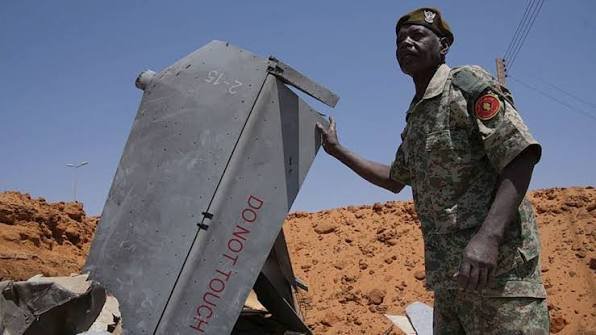
Sudan’s devastating civil war is entering an increasingly dangerous phase as armed drones transform the battlefield, extend the reach of military operations and cause mounting civilian casualties. What was once largely a conflict fought through conventional weapons, artillery and ground offensives has evolved into a war in which unmanned aerial vehicles (UAVs) are increasingly determining military strategies and threatening communities far beyond the traditional frontlines.
A series of deadly drone attacks across Sudan in recent months has highlighted the growing humanitarian consequences of this technological shift. Markets, transport hubs, residential neighbourhoods and other civilian locations have become increasingly vulnerable to aerial strikes. For ordinary people, the danger is no longer limited to areas where opposing forces are directly confronting each other. The possibility of an unexpected attack has become part of everyday life, leaving communities struggling to find safety in a country already devastated by prolonged conflict.
One of the deadliest recent incidents occurred on 18 October in Al-Dibab, a town in West Kordofan state. Hundreds of people had gathered at a busy transport hub near a market, waiting to board trucks that would take them home. A drone struck the crowded location, and approximately 10 minutes later, another drone hit the same area. At least 139 people were killed in the two attacks.

The second strike raised particular concerns because attacks of this nature can kill or injure people who arrive to assist the initial victims, including emergency responders, volunteers and bystanders. Such tactics are commonly described as double-tap strikes and can dramatically increase the number of casualties when an area remains crowded after the first explosion.
The horror continued eight days later when another drone attack struck a busy market in Nyala, the capital of South Darfur. Emergency Lawyers, a rights organisation monitoring violence in Sudan, estimated that 103 people were killed. The personal consequences were reflected in the account of one local resident who told Agence France-Presse that he had lost his 19-year-old son. According to his testimony, his family buried the young man alongside more than 70 other bodies at a single location.
These incidents represent part of a wider pattern of increasingly deadly aerial attacks. According to the United Nations, drones killed at least 306 people and injured hundreds more during the first three weeks of October alone. The figures demonstrate how rapidly drone warfare has become one of the most significant threats to civilian life in Sudan.
The conflict began in April 2023 after a power struggle between the Sudanese Armed Forces (SAF) and the paramilitary Rapid Support Forces (RSF) escalated into fighting in the capital, Khartoum. What initially emerged as a confrontation between two powerful military organisations has developed into a nationwide humanitarian catastrophe. Estimates of the overall death toll vary considerably, ranging from approximately 150,000 to more than 400,000. Millions of people have been displaced, while large sections of the population face severe food shortages and limited access to essential services.
The nature of the fighting has also changed considerably since the beginning of the war. Initially, the Sudanese military relied heavily on fighter jets, attack helicopters, tanks and long-range artillery. The RSF, meanwhile, made extensive use of heavily armed pickup trucks, machine guns, anti-aircraft weapons, anti-tank systems and rocket launchers.
However, the increasing availability and deployment of drones have introduced a new dimension to the conflict. Investigators at the Centre for Information Resilience (CIR), an organisation that conducts open-source investigations, documented the use of weaponised drones in Sudan as early as July 2023. Since then, the frequency of attacks has increased significantly. One investigator described the situation by observing that reports of drone strikes have become almost a daily occurrence.
A CIR investigation published recently identified 21 different unmanned aerial vehicle models used in Sudan since the conflict began. These included surveillance and reconnaissance aircraft as well as combat drones. The investigation identified 10 models associated with the RSF and allied forces, manufactured in Belarus, China and Russia. Five models were identified as being used by the Sudanese military and aligned forces, with manufacturing origins in Iran, Sudan and Turkey.
The growing sophistication of these weapons has further changed the battlefield. Smaller first-person-view drones, commonly known as FPV drones, were widely used earlier in the conflict. These relatively small aircraft can be directed towards targets and used in kamikaze-style attacks. However, both sides are increasingly turning towards larger drones capable of travelling much longer distances and carrying precision-guided munitions.
Such developments have expanded the geographical reach of military operations. Armed groups can now strike targets located far from their immediate positions, making it increasingly difficult for civilians to predict where attacks might occur.
According to Ali Mahmoud Ali, a Sudan analyst at conflict-monitoring organisation Acled, the two sides have developed different patterns of drone deployment. The Sudanese military generally uses drones to attack RSF bases and disrupt fuel supplies and other logistical routes serving territories controlled by the paramilitary group. The RSF, meanwhile, has frequently targeted infrastructure, including electricity facilities, water stations, airports and hospitals, in areas controlled by the military.
Ali explained that drones have become essential to gaining advantages in ground operations because control of the air can make it easier for forces to advance and secure positions. He described the drone as a central weapon in warfare taking place away from the main frontlines.
The consequences for civilians are particularly alarming. According to the United Nations Human Rights Office, drone strikes accounted for at least 880 civilian deaths between January and April 2026. This represented more than 80 per cent of all conflict-related civilian fatalities during that period. Commercial areas, markets, residential neighbourhoods and military facilities have emerged as some of the most frequently struck locations.
For residents, the constant threat has created an atmosphere of fear and uncertainty. Ali Salih, a resident of El Obeid, the capital of North Kordofan, said people in the area had gradually become accustomed to hearing about drone attacks. He recalled being at home during a recent strike that reportedly killed three people and injured several others.
Although residents attempt to continue their daily activities, he explained that repeated attacks have made ordinary life increasingly difficult, particularly for people living near locations that could become military targets. The possibility of an unexpected strike has affected people’s ability to work, travel and maintain normal family routines.
The humanitarian consequences extend beyond the immediate loss of life. In early November, Denise Brown, the United Nations resident and humanitarian coordinator in Sudan, warned that intensifying drone attacks were disrupting electricity, water and fuel supplies while also making humanitarian operations more difficult.
The damage to essential infrastructure has serious implications for hospitals and vulnerable communities. Patients requiring regular dialysis treatment face the possibility of interrupted medical care, while women giving birth may be forced to receive treatment in hospitals without reliable electricity. Surgical operations can also become impossible when power supplies and medical equipment are disrupted.
The impact on children is especially concerning. James Elder, a spokesperson for UNICEF, said that two-thirds of child injuries and deaths in Sudan this year had been caused by drones. He warned that aerial attacks were bringing warfare into locations that had previously been considered relatively safe. Children who need access to education, clean water and protection are increasingly exposed to the consequences of military operations.
The growing use of drones is also affecting regional relations. On 19 October, a drone strike in the disputed Abyei region along the Sudan-South Sudan border reportedly targeted an RSF fuel depot but hit a market instead, killing at least 153 people. The incident demonstrated how attacks intended to damage military supply networks can have devastating consequences for civilians and communities in politically sensitive border areas.
Sudan’s foreign ministry has also accused the United Arab Emirates of supplying drones used by the RSF in attacks against electricity infrastructure in military-controlled territories, alleging that the aircraft were launched from Ethiopia. Both the UAE and Ethiopia have denied supporting the paramilitary group. These competing claims underline the complexity of the conflict and the difficulty of independently establishing responsibility for particular attacks.
Investigators have warned that the growing use of drones has made attribution more complicated. Their long operational ranges allow combatants to strike targets from locations far behind the frontlines, while the variety of aircraft and their supply networks make it harder to determine where particular weapons originated and who was responsible for individual operations.

For Sudan’s civilian population, however, the immediate concern is survival rather than the technical or political dimensions of drone warfare. Families are losing loved ones in markets, transport centres and residential areas, while essential services continue to deteriorate. The expansion of aerial attacks has made displacement, hunger and insecurity even more difficult to escape.
As Sudan’s conflict continues, the increasing use of armed drones presents a serious challenge to international efforts to protect civilians and deliver humanitarian assistance. The scale of the recent casualties reinforces the need for all parties to respect international humanitarian law, distinguish between military objectives and civilian populations, and take every feasible precaution to prevent indiscriminate attacks.
Without stronger protection for civilians, accountability for violations and meaningful efforts to reduce the violence, Sudan risks experiencing an even deeper humanitarian catastrophe. The country’s skies, increasingly dominated by armed drones, have become another source of fear for millions of people who are already struggling to survive one of the world’s most devastating ongoing conflicts.
Related News:
 UAE Nominee Faces Backlash Over Sudan War Role
 Ebola outbreak in DRC overwhelms health system as cases surge
 New Footage Revives Peter Falconio Mystery
 Israeli Strike in Southern Lebanon Kills Seven
 Ukraine Villagers Demand Answers After Deadly Arms Depot Strike
 Daughter Finds Bones in Parents’ Burned-Out Car
 Argentina Orders Return of Nazi-Looted Painting
 Royal Crown Branded Enslaved Africans in Britain’s Slave Trade
 Israel Accused of Undermining Palestinian Life

 Gaza Strike Kills Child and Paramedic
 South Africa’s Femicide Crisis Deepens
 Ukraine and Russia Escalate Long-Range Drone War
 Latin America women fear rollback of rights
 South Sudan Trauma Wards Struggle as Fighting Intensifies
 Israel Promotes Film Challenging Controversial Gaza Documentary
 Navi Pillay Wins Nobel Peace Prize for Justice
 Senegal LGBTQ+ Crackdown Drives People Into Hiding
 Ben Roberts-Smith Denies War Crime Allegations in First Statement
 Police Suspect Help in Missing Alice Springs Girl Case
 Cartel crackdown raises fears of fresh violence
 US ‘Narco Boat’ Strikes Draw Global Outcry
 Search Intensifies for Missing Hiker on WA Bibbulmun Track
 China mine blast death toll rises to 90
 Ukraine Creates Long-Range Strike Command
 Dreyfus Statue Finally Gets Permanent Paris Home
 Five Years of Taliban Rule Leave Afghanistan in Crisis
 Survivor Sues Musk’s xAI Over AI Abuse Images
 UN expert urges UK to rethink Israel policy
 Family of British man found dead in Grenada urges UK-Grenada police cooperation
 Miliband Rejects Chief Rabbi’s West Bank Warning
 Harrods Faces Dispute Over Fayed Abuse Compensation
 Japan PM Backs International Criminal Court
 King Refers Jamaica Slavery Petition to Privy Council
 UK Pauses Chagos Deal Amid US Opposition
 Fayed Survivors Demand Inquiry Into Medical Regulator
 Economic growth and political strain reshape Benin
 Tennessee Execution Fails After Two Lethal Doses
 Almost Half of Fayed Accusers May Be Trafficking Victims
 Tigray rebels accused of recruiting boys as war returns
 Iran Nobel Laureate Reveals Prison Torture and Fears
 Kenya Confirms First Ebola Case as Patient Dies
 Former German Intelligence Chief Arrested Over Espionage
 Christa Pike Wakes After Failed Tennessee Execution
 EU Divisions Deepen Over Israel Policy
 Three Convicted in Mexico Surfing Trip Murders
 UAE Says Co-Pilot Planned Suicide Attack on Israel
 Controversial Vaccine Trial Approved in Guinea-Bissau
 Church of England Reparations Fund Faces Growing Backlash
 Lamarre-Condon Trial Hears Phone Disposal Request
 French Police Face Scrutiny Over Injured Teenagers
 Saudi Arabia Faces Outcry Over Execution of Former Minor
 UK Bill Faces Warning Over Fayed Trafficking Victims
 Zelenskyy Says US Failed to Warn Kyiv of Russian Strikes
 Nigeria Confirms Ebola Case as Regional Outbreak Spreads
 Russia Strikes Kyiv After Agreeing to Resume Peace Talks
 Serbia’s Student Victory Sparks a ‘Smell of Freedom’
 Trump’s Midterm Campaign Faces Racism and Political Backlash
 King Charles Faces Caribbean Slavery Apology Demands
 Amnesty Alleges Cambodian Officers Guarded Scam Compounds
 Spain Train Crash Kills 69, Foreign Victims Identified
 Alan Jones Trial Paused for Melbourne Cup Viewing
 ANC Faces Voter Backlash in South African Elections
 Seven Arrested After Bonfire Night Violence in Scotland
 Paraguay President Impeached and Arrested After Banking Crisis
 Kraków Shooting Suspect Dies After Killing Six
 Orbán’s Brother Detained in Smuggling Probe
 Ukraine Captures First Indonesian Fighter in Russian Army
 Gaza Floods Leave Thousands Homeless as Tents Await Entry
 Kenyan Mother Faces 100 Lashes in Saudi Arabia
 Teenager Found Alive After Six Days Lost in Australian Bush
 Iran Death Row Boxer Wins Prestigious Human Rights Award
 US Indictment Reveals New Links in RAF Fairford Case
 Greene Pushes Epstein Files Amid Trump Fallout
 Kelly Wilkinson Inquest Reveals Bail Failure
 Maldives Cave Diving Tragedy Raises Safety Alarm
 British Columbia Sues OpenAI Over School Shooting
 London Facial Recognition Trial Ends With False Alert
 South Africa Withdraws Directive on Asylum Applications
 Elizabeth Struhs Inquest Examines Child Safety Failures