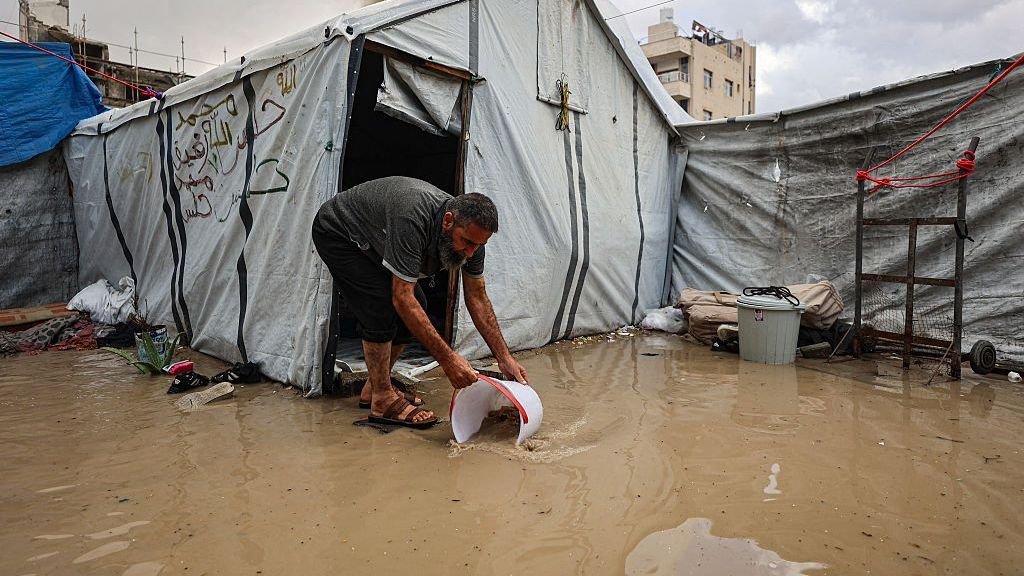
Tens of thousands of displaced Palestinians in the Gaza Strip are struggling to survive in damaged, flooded tents after severe storms and heavy rainfall battered the coastal territory, exposing families to freezing temperatures, disease and increasingly dangerous living conditions. The humanitarian crisis has intensified as aid organisations warn that approximately 150,000 tents remain outside Gaza awaiting permission to enter, despite the urgent need for adequate shelter before the arrival of winter.
The latest storms, which brought heavy rain and powerful winds over the weekend, destroyed or damaged makeshift shelters across several displacement camps. Thousands of families were left without adequate protection as rainwater entered their tents, soaked their belongings and flooded already overcrowded living spaces. The destruction has also affected sanitation facilities, with sewage reportedly flowing into areas where displaced families are taking shelter, creating additional health risks.

At least four Palestinian children and a woman were reportedly killed in weather-related incidents during the weekend. Among the victims was a child who drowned in floodwater. At least three other children and their mother died after a large sand dune collapsed onto their tent, burying the family beneath sand and debris. The incidents have highlighted the extreme vulnerability of displaced families living in temporary shelters that offer little protection against severe weather.
For many Palestinians, the latest rainfall has transformed an already desperate humanitarian situation into an immediate struggle for survival. Families who have repeatedly lost their homes during the conflict are now facing another winter without reliable housing, electricity, sanitation or sufficient access to essential supplies.
Raed Jamal, a displaced Palestinian living in a damaged tent, described the devastating impact of the storms on his family. He said that all their clothes had become soaked in the rain and that his children had fallen ill. Unable to afford replacement clothing, he expressed deep distress at watching them suffer in the cold.
Jamal explained that the situation inside his tent had become extremely difficult, with rainwater continuously entering through damaged sections of the roof. During the night, he had to use household pots to collect the water falling inside the shelter. Videos shared by him showed the fragile structure shaking under powerful winds while rain passed through holes in its covering.
His experience reflects the conditions facing thousands of families who have been forced to depend on temporary shelters for an extended period. For parents, the greatest concern is often the health and safety of their children, particularly infants and young people who are more vulnerable to cold temperatures, respiratory infections and exposure to contaminated water.
Humanitarian organisations have warned that the health consequences could become increasingly severe unless displaced families receive stronger shelters, warm clothing and essential winter supplies. Medical Aid for Palestinians, a UK-based humanitarian charity, has expressed concern about a possible increase in respiratory illnesses and other health complications linked to prolonged exposure to cold, damp and overcrowded conditions.
Mai Elawawda, the organisation’s communications officer in Gaza, warned that medical teams expected to encounter more patients suffering from health problems associated with the deteriorating living environment. She also expressed fears that additional children could die from hypothermia, as happened during the previous winter.
The United Nations has estimated that approximately 940,000 people in Gaza are living in areas exposed to flooding risks. Many are staying in makeshift tents that provide little protection against heavy rainfall. The danger has been compounded by the failure of stormwater pumping facilities, which are not operating because of inadequate electricity supplies.
Without functioning drainage systems, accumulated rainwater can quickly overwhelm displacement camps, leaving families surrounded by contaminated water. Damaged sanitation infrastructure further increases the possibility of disease outbreaks, particularly in densely populated areas where access to clean water and medical facilities remains severely limited.
According to the United Nations, approximately 26,000 households sought assistance following the latest rainfall, while at least 3,900 households were left without any shelter. These figures demonstrate the scale of the immediate humanitarian emergency and the difficulties facing organisations attempting to provide assistance across the territory.
The shortage of suitable shelters has become one of the most pressing concerns as winter approaches. ShelterBox, an international humanitarian organisation specialising in emergency shelter assistance, said that tents it would normally distribute during humanitarian emergencies had been waiting outside Gaza for almost two years because of restrictions on their entry.
Unable to deliver its standard shelter materials, the organisation has been forced to consider alternative arrangements using tarpaulins and wooden pallets. However, even these materials have faced restrictions, limiting the ability of humanitarian workers to provide families with more reliable protection.
A ShelterBox spokesperson said the latest flooding had demonstrated why more durable shelter solutions were urgently needed. The organisation warned that continued dependence on emergency materials was leaving families in structures that could not withstand the weather conditions experienced in the region.
The spokesperson also highlighted the difficulties humanitarian organisations face when attempting to bring construction materials and other essential supplies into Gaza. According to the organisation, restrictions on certain items and the unpredictable approval process have made humanitarian planning increasingly complicated.
Aid workers say the problem is not simply the availability of tents but also the restrictions affecting the wider range of materials required to construct safer shelters. Families need protective coverings, wooden structures, insulation, tools and other essential supplies to create living spaces capable of withstanding heavy rainfall and strong winds.
The situation has become particularly concerning because Palestinians are facing their second winter since a ceasefire agreement was reached more than a year ago. Humanitarian workers had hoped that the agreement would create opportunities to improve living conditions, restore essential infrastructure and expand the delivery of assistance. However, aid agencies say restrictions on humanitarian supplies and delays at border crossings have prevented the necessary improvements.
One major obstacle involves restrictions on so-called dual-use items, which Israeli authorities regulate because some materials can potentially have both civilian and military applications. Humanitarian organisations argue that the restrictions have also affected supplies needed for reconstruction, shelter construction and essential infrastructure repairs.
The Council for Arab-British Understanding has called on the British government to increase diplomatic pressure on Israel to allow humanitarian supplies into Gaza. The organisation has also urged the restoration of licences for humanitarian groups, including Médecins Sans Frontières, Oxfam and the Norwegian Refugee Council.
Joseph Willits, the organisation’s head of parliamentary affairs, said the predictable winter rains had struck an already devastated population suffering from disease and malnutrition. He argued that restrictions preventing essential shelter materials from entering Gaza were contributing to a humanitarian crisis that could have been anticipated and addressed.
Meanwhile, questions have also emerged over the number of aid trucks reportedly entering Gaza and how their cargo is calculated. Israeli authorities have claimed that an average of 600 trucks are being allowed into the territory each day. However, the Israeli human rights organisation Gisha has questioned the figures and raised concerns about transparency in the reporting of humanitarian deliveries.
According to Gisha, Israeli authorities count 12 pallets of goods as one truck, although a typical truck can carry approximately 20 pallets. The organisation argues that this calculation could mean the actual volume of goods entering Gaza is significantly lower than the headline figures suggest, potentially representing a reduction of around 40 per cent in cargo capacity.
The organisation has also criticised what it describes as stricter restrictions on goods entering Gaza compared with previous ceasefire arrangements. These concerns have intensified calls for greater transparency regarding which supplies are approved and how quickly humanitarian shipments can reach people in need.
Israel has claimed that 10,000 tents were allowed into Gaza last week. However, humanitarian organisations say the figure remains far below the estimated requirements. The United Nations has reported that approximately 150,000 tents are waiting outside the territory for permission to enter, while an estimated 94 per cent of Palestinians in Gaza require assistance to secure adequate shelter.
For families who have already lost their homes, these delays have immediate and deeply personal consequences. Nour al-Batsh, a mother of a seven-month-old child, said she was forced to rent a partially destroyed apartment after her tent collapsed. She now shares the accommodation with other people and pays approximately $500 per month, relying on donations from abroad to meet the cost.
Al-Batsh described the cold as potentially lethal, particularly for families living in tents near the sea. She warned that the combination of freezing temperatures, strong coastal winds and inadequate shelter could place lives at risk as winter approaches. Although she has managed to find temporary accommodation, she remains deeply concerned about the possibility of having to return to her damaged tent.

Her experience illustrates the impossible choices confronting displaced families: remain in unsafe shelters exposed to flooding and freezing temperatures or spend money on damaged accommodation that many cannot afford.
As the humanitarian situation deteriorates, aid organisations are urging authorities to accelerate the approval of shelter supplies, improve access for humanitarian workers and allow essential construction materials into Gaza. They warn that without immediate action, further rainfall could leave thousands more families homeless and expose vulnerable children to potentially fatal health conditions.
For Gaza’s displaced population, the arrival of winter is no longer simply a seasonal challenge. It represents another test of survival for families who have already endured prolonged displacement, destruction and uncertainty. With hundreds of thousands of people facing inadequate shelter, humanitarian organisations fear that the consequences of delayed assistance could become increasingly devastating in the weeks ahead.
Related News:
 South Sudan Trauma Wards Struggle as Fighting Intensifies
 Zelenskyy Says US Failed to Warn Kyiv of Russian Strikes
 China Fireworks Factory Blast Kills 21 in Hunan
 China mine blast death toll rises to 90
 Ebola outbreak in DRC overwhelms health system as cases surge
 Pope Meets Families in Italy Toxic Waste Zone
 Dreyfus Statue Finally Gets Permanent Paris Home
 Israeli Strike in Southern Lebanon Kills Seven
 Five Years of Taliban Rule Leave Afghanistan in Crisis
 Nepal Flood Survivors Face Unimaginable Loss
 Daughter Finds Bones in Parents’ Burned-Out Car
 Nepal Tunnel Rescue Offers Hope Amid Flood Devastation
 Yemen War Displaces 125,000 as Fighting Intensifies
 Gaza Strike Kills Child and Paramedic
 South Africa’s Femicide Crisis Deepens
 Japan PM Backs International Criminal Court
 King Refers Jamaica Slavery Petition to Privy Council
 Ukraine and Russia Escalate Long-Range Drone War
 Nepal PM calls deadly flood a global climate warning
 Yemen fighting forces children out of school and into work
 Fayed Survivors Demand Inquiry Into Medical Regulator
 Israel-bound Plane Lands in Saudi Arabia After Cockpit Fight
 Pilot Recalls Fight to Save Flydubai Passengers
 Latin America women fear rollback of rights
 Pacific Climate Summit Draws Limited Global Leaders
 WHO Says Russia Plague Epidemic Risk Remains Low
 WHO Seeks Russia Answers Over Suspected Plague Death
 Indonesia Faces Lawsuit Over Escalating Wildfire Haze
 Israel Promotes Film Challenging Controversial Gaza Documentary
 Navi Pillay Wins Nobel Peace Prize for Justice
 Three Convicted in Mexico Surfing Trip Murders
 Indonesia Tests Dry Ice as Toxic Haze Spreads Across Asia
 Senegal LGBTQ+ Crackdown Drives People Into Hiding
 Climate Change Makes Tap Water Unsafe in Arctic Norway
 Zelenskyy Accuses US of Delaying Ukraine Missile Supplies
 Helen Haines Loses Both Legs After Alleged Attack
 Melting Dolomites Glaciers Reveal 250 WWI Explosives
 King Charles Faces Caribbean Slavery Apology Demands
 El Niño Drought Pushes Papua New Guinea Into Crisis
 UK Ministers Warned Over Lobbying by Indian Mega-Zoo
 Barrister Criticises Trial After Suicide Case Verdict
 Maldives Cave Diving Tragedy Raises Safety Alarm
 New Footage Revives Peter Falconio Mystery
 Ukraine Creates Long-Range Strike Command
 UK Schools Struggle as Classrooms Top 40C
 London Tube Heat Reaches Dangerous Levels
 Olympus Awaits Unesco Heritage Recognition
 Powerful 7.7-Magnitude Earthquake Hits Eastern Indonesia
 Australia Races to Find Tourists Missing in Nepal
 Ukraine Villagers Demand Answers After Deadly Arms Depot Strike
 Typhoon Saudel Triggers Mass Evacuations in China
 Royal Crown Branded Enslaved Africans in Britain’s Slave Trade
 Israel Accused of Undermining Palestinian Life
 Clancy Defense Seeks Inquiry Into Lone Juror
 Tropics May Wait Longest for Net-Zero Climate Benefits
 Greece Pushes for Parthenon Marbles Reunification
 Tennessee Set to Execute Woman After Clemency Denied
 Pelicot Trial Play Comes to London for One Night
 New Maps Reveal Gaza’s Vast Destruction
 Europe’s Record Heat Summer Signals Climate Risks
 French School Protests Escalate as 400 Schools Close
 Iran Nobel Laureate Reveals Prison Torture and Fears
 Kenya Confirms First Ebola Case as Patient Dies
 Okinawa US Troops Face Curfew After Murder Case
 Police accused of failing abuse victims
 UK Pharmacy Body Drops Teva After Ethical Concerns
 Gaza War Deepens India’s Strategic Ties With Israel
 EU Divisions Deepen Over Israel Policy
 Panama Hit by Powerful 7.7-Magnitude Earthquake
 US Execution Livestream Plan Sparks Global Outrage
 Australian Advocates Seek Subsidised Drugs for PMOS
 Hanson Attacks Taylor as Australian Conservatives Clash
 Mexico Storms Leave Five Dead as Flooding Worsens
 Elizabeth Struhs Inquest Examines Child Safety Failures
 Iranian Woman Faces Death Sentence Over Social Media Post
 Gadi Eisenkot: Israel’s Anti-Netanyahu Challenger
 UK Bill Faces Warning Over Fayed Trafficking Victims
 Fire Engulfs Hitler’s Eagle’s Nest Retreat
 Alan Jones Trial Paused for Melbourne Cup Viewing