Published: 12 October 2026. The English Chronicle Desk. The English Chronicle Online
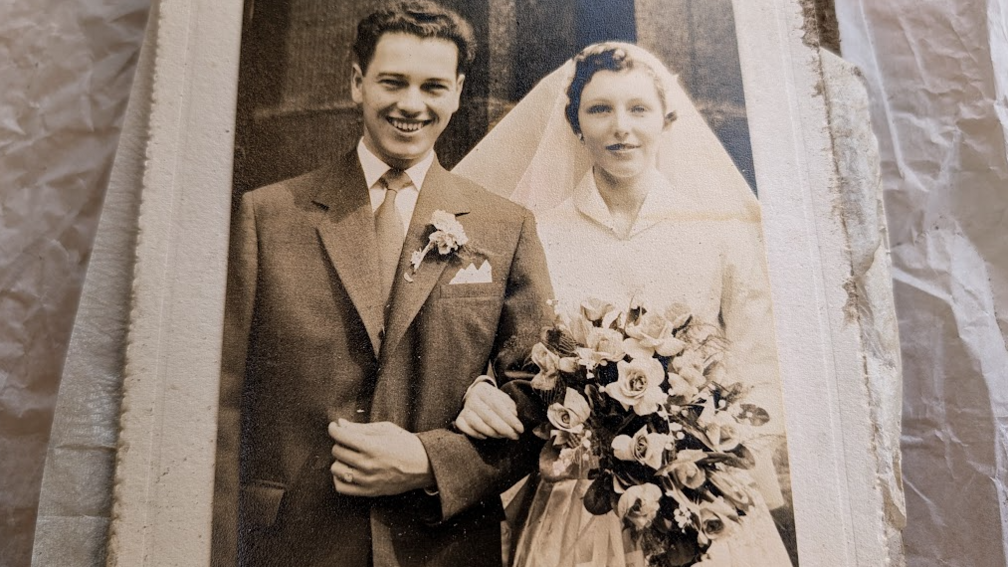
A decades-old wedding album discovered abandoned outside a café in Wakefield, West Yorkshire, has been returned to the family after an online appeal and determined research by a local historian uncovered its remarkable story. The photographs, taken at a wedding in 1957, belonged to Maxwell Dawson and Barbara Parr and were among the few surviving images of the couple treasured by their son, Michael Dawson.
What initially appeared to be an unwanted collection of old photographs has become a deeply emotional reunion, restoring a precious part of a family’s history after the album was stolen from a storage unit. The discovery has also demonstrated how community goodwill, social media and painstaking local research can help reunite lost possessions with the people who value them most.
The story began when Andrew Bedford, who runs Eva’s Kitchen café in Wakefield city centre, came across the album dumped outside his business. At first, he considered throwing it into a nearby wheelie bin. However, when he opened it and saw the vintage photographs of a bride and groom celebrating their wedding, he realised that the collection might hold considerable sentimental value.

The names handwritten in the album had faded to the point where the couple could not immediately be identified. Rather than discard the photographs, Bedford rescued them and took the album inside his café, where it could be kept safe while efforts were made to find its rightful owner.
His partner, Éva Lemperger, then turned to social media to ask for help identifying the couple. The appeal invited members of the public to examine the photographs and share any information that might establish who the people were and where the album had come from.
The appeal soon attracted attention beyond the immediate neighbourhood. When the local newspaper reported the discovery, it reached Anne-Marie Fawcett, a local historian and amateur investigator with a particular interest in family history. Fawcett runs a local history group on Facebook with more than 15,000 members, giving her access to a community with knowledge of local families, historical records and connections that might otherwise have remained undiscovered.
For Fawcett, the unidentified album presented exactly the kind of mystery she enjoys investigating. She was drawn to the possibility that old photographs, faded handwriting and seemingly minor historical details could help reveal the identities of people whose family memories had been lost.
Her investigation required patience and careful comparison of different records. One important clue came from the birth certificate of another person who had attended the wedding. That information helped her identify Wadsley Parish Church in Sheffield as the likely location of the ceremony.
The church connection provided a starting point, but identifying the couple proved more complicated. Fawcett used a photo-enhancement tool to make the faded handwriting more legible and decipher the bride’s name, which appeared to be Barbara Parr. However, historical records contained more than one person with that name, meaning she could not rely on the name alone to establish the correct identity.
Instead, she continued investigating the available records and looking for connections that could distinguish one Barbara Parr from another. An electoral roll entry eventually suggested that a man named Maxwell Dawson, believed to be Parr’s husband, had lived near Wakefield.
That geographical connection strengthened her suspicion that she had found the right couple. She then appealed on social media for further information about the family, hoping someone might recognise the names or provide a link to their surviving relatives.
A further breakthrough came through an old school friend of Michael Dawson. The former classmate remembered him and helped Fawcett locate a photograph that enabled her to identify and contact him through Facebook.
When Fawcett sent Dawson a message, he responded by telephone. The conversation confirmed that the album contained photographs of his parents, Maxwell Dawson and Barbara Parr, who had married in 1957.
The identification revealed why the discovery mattered so much. Dawson explained that the album had been stolen from a storage unit where he and his brother had placed treasured belongings from their parents’ home after their deaths. The break-in had resulted in the loss of family heirlooms, leaving the brothers without possessions that carried years of personal and family memories.
The wedding album was therefore far more than an old collection of photographs. It preserved images of Dawson’s parents on a significant day in their lives, offering a tangible connection to people whose memories remained important to him.
For families, photographs often become especially valuable after loved ones die. They can preserve expressions, relationships, clothing and moments that may never have been recorded in writing. When other personal belongings disappear, surviving photographs can become irreplaceable reminders of a family’s past.
Dawson said he had believed he had lost everything when the storage unit was broken into. The return of the album brought relief and happiness because of the importance he attached to the images. He described himself as sentimental and said the photographs were particularly meaningful because so few surviving pictures of his parents remained available to him.
He also expressed gratitude for Fawcett’s determination, acknowledging the effort required to trace his family through historical documents, electoral records, social connections and online searches. In a light-hearted comment, he joked that the historian probably knew more about him than he knew about himself, reflecting the depth of research she had undertaken to locate him.
Despite the humour, his appreciation was unmistakable. He said he had thought everything was gone and could not thank Fawcett enough for helping him recover the photographs.
Dawson has vowed to protect the album carefully from now on, saying he would protect it with his life because it represented almost all he had left of his parents in photographic form. His reaction captures the emotional weight that personal possessions can carry, particularly when they are connected to relatives who are no longer alive.
Bedford was equally pleased that the album had found its way back to the family. He explained that he had imagined how he would feel if he had lost the only photographs he possessed of his own relatives. Knowing that someone had found them and returned them would, he said, have brought enormous relief and happiness.
That sense of empathy helped shape the decision to preserve the album rather than throw it away. What could easily have been treated as rubbish was instead recognised as something that might be priceless to another person.
Fawcett also described the reunion as an emotional moment. She said she felt a physical reaction while discussing the case because she understood the significance of returning an irreplaceable family possession. The successful outcome was especially satisfying because it transformed an unexplained discovery into a personal story with a clear and happy resolution.
The case highlights the value of local history groups and online communities in recovering lost items. Historical records can provide essential clues, but they often become more useful when combined with the memories and knowledge of people who know a town, its families and its past. In this instance, the combination of an alert café owner, a social media appeal, a newspaper report, archival research and a former school friend ultimately solved the mystery.
It also demonstrates how ordinary members of the public can make a difference simply by taking the time to preserve an object whose significance is not immediately apparent. The album’s return depended on several people choosing to investigate rather than ignore it, each contributing a small but important part of the process.
Although the photographs had been separated from their owner following the theft, their discovery in Wakefield created an unexpected opportunity to recover them. The investigation did not restore every stolen heirloom, but it returned something that could never have been replaced by money alone.

For Michael Dawson, the recovered wedding album represents a renewed connection to Maxwell Dawson and Barbara Parr and to a moment they celebrated nearly seven decades ago. For Bedford, Lemperger and Fawcett, the outcome offers a reminder that seemingly minor acts of kindness and curiosity can have a lasting effect on another family.
The mystery of the 1957 wedding photographs has now been solved, but its significance extends beyond identifying two people in an old album. It is a story about memory, community and the enduring value of family history, showing how photographs once feared lost forever can find their way home through persistence, cooperation and compassion.
Related News:
 Millions of Enslaved Records Open New Family History Path
 Roman Finds Reveal Bath’s Suburban Past
 UK Banks Maintain £100 Contactless Limit Despite FCA Rule Change
 Rising Costs Force Families to Rethink Days Out
 Archbishop Prays for Middle East Peace in First Easter Sermon
 Kezia Dugdale Warns of Possible Reversal of Equal Rights Gains
 Synagogue Arson Attempt Sparks Security Fears
 NHS Safety Fears as Nurses Cover Doctor Gaps
 Two Children Die in Wolverhampton House Fire Tragedy
 Reform UK funding: mystery billionaire revealed
 John Terry Faces Backlash Over Political Posts
 Greens Face Internal Row Over Antisemitism Claims
 Barrister Criticises Trial After Suicide Case Verdict
 Tractor Breakdown Tests Lincolnshire Farmers
 Labour Members Turn Against Starmer Leadership
 Britons Build Emergency Supplies Amid Rising Fears
 Sycamore Gap Artwork Chosen After Public Vote
 Farage and Reform UK Reshape British Politics
 Starmer Leadership Under Pressure After Setbacks
 UK Nations Brace for Potential Breakup Amid Reform Surge
 British Teens in EU Face Soaring UK University Fees
 UK Schools Struggle as Classrooms Top 40C
 London Tube Heat Reaches Dangerous Levels
 Three-Quarters of England’s Riverbanks Still Off Limits
 Westminster Council Threatens Charing Cross Soup Kitchen
 BBC Warned About Missing Clothes of Murder Victim
 Burnham unveils £65m drought aid for farmers
 Queue row erupts on Wales’ highest mountain
 RAF Barnham Protests Fuel Tensions in Norfolk Town
 UK Households Could Save £173 on Fixed Energy Deals
 British Museum Faces Questions Over Peter Thiel’s Private Bayeux Viewing
 Internal Exclusions Surge in England’s Schools
 Green Leader Targets Starmer’s Former Seat
 UK Subsidence Claims Surge After Record-Breaking Summer
 Masked Protesters Bring Dover Port Traffic to Standstill
 UK House Prices Fall as Mortgage Rates Rise
 Councils spend £125m on illegal children’s care
 Patriot Platform Raises Concern Across Britain
 UK Retailers Accused of Breaking Refund Laws
 Mahmood Warns Far Right Over Asylum Protests
 Disabled Travellers Seek Fairer UK Care Rules
 NHS Breast Care Review Finds Serious Patient Harm
 UK Rent Gap Puts Low-Income Families Under Pressure
 Lib Dems Prepare for Election Amid Reform Challenge
 Headteachers Warn New Ofsted System Is Harming Wellbeing
 Labour Apprenticeship Scheme Faces Slow Start
 Briton Faces Cyprus Court Over Son’s Fatal Fall
 King Refers Jamaica Slavery Petition to Privy Council
 GP List Policy Risks Cutting Off Vulnerable Patients
 Greece Pushes for Parthenon Marbles Reunification
 Elif Eralp Emerges as Berlin’s Next Political Force
 Frome Community Loses Bid for Major Regeneration Site
 Free Speech Emerges as Key UK Election Issue
 Burnham Opens Debate on Pension Triple Lock for Care
 London Facial Recognition Trial Ends With False Alert
 Pelicot Trial Play Comes to London for One Night
 UK University Strikes Spread as Financial Pressure Grows
 Burnham Opens Door to Possible UK Return to EU
 Poundland Rescue Bid Could Protect 11,000 Jobs
 Drumcree Talks Falter as Legal Challenge Deepens
 UK-France Returns Deal Faces Expiry as Talks Stall
 Healey urged to act as UK energy bills rise 4%
 Green Party faces dispute over Zionism motion
 Edinburgh Glasshouses Reopen After Major Restoration
 Badenoch Raises Prospect of 2027 UK Election
 Polanski Says Leadership Not Tied to By-election Result
 BT Broadband Pauses Raise Digital Switchover Concerns
 Experts Warn UK Food Security Is at Risk
 Gosport Protesters Clash With Police Over Migrant Rescue
 Police accused of failing abuse victims
 Bendy Elm Named UK Tree of the Year
 Britons Demand Greater Honesty on Climate Crisis
 Luton Residents Reject Claims of ‘No-Go Zones’
 Labour Wins Key London By-election as Greens Fall Short
 UK Water Firms Earn Millions From Industrial Wastewater
 Burnham Rises as Farage and Polanski Face Setbacks
 Milburn Proposes Pre-Apprenticeship Route for Young People
 UK Savers Face Uncertainty as Rates Rise Above 5%
 British Military School Abuse Victims Denied Justice
 UK Greens Face Crisis Over Zionism and Extremism Row