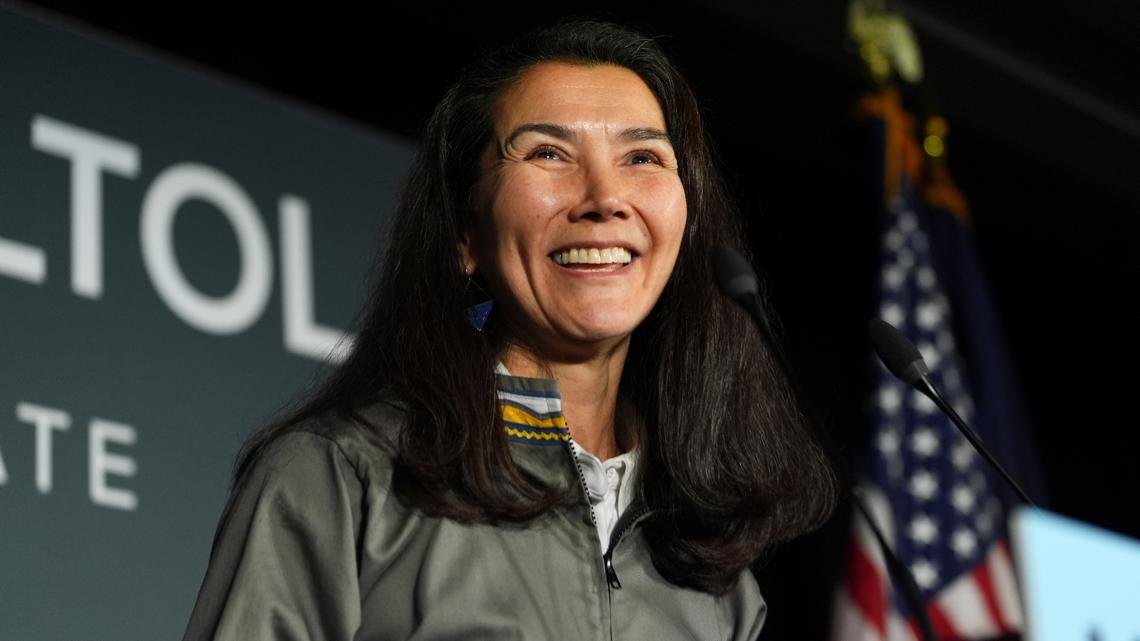
Democrat Mary Peltola has secured a historic victory in Alaska’s closely watched Senate election, defeating Republican incumbent Dan Sullivan and delivering another significant political setback to Donald Trump’s Republican Party. Her victory gives Democrats control of 56 seats in the United States Senate, marking a major shift in the balance of power in Washington following the 2026 midterm elections.
The result, announced approximately two weeks after Americans went to the polls, makes Peltola the first Democrat elected to represent Alaska in the Senate since 2008. Her victory is particularly significant because Alaska has traditionally remained a stronghold of Republican support, especially in presidential elections. It also represents a remarkable political comeback for Peltola, who lost her congressional re-election campaign in 2024 despite having previously established herself as one of the state’s most recognisable political figures.

Peltola, a former member of the US House of Representatives and a member of the Yup’ik community, built her campaign around the economic concerns, cultural identity and everyday challenges facing Alaskans. Her message focused on reducing living costs, protecting working families, addressing corporate influence and ensuring that Alaska’s interests receive greater attention in Washington.
In a statement following her victory, Peltola said voters across Alaska had delivered a clear message that the existing political situation in Washington was not working for their state. She described her election as an opportunity to challenge established political practices, confront corporate greed and deliver meaningful improvements for ordinary families.
She also emphasised her lifelong connection to Alaska, arguing that her experience growing up in the state gave her a deeper understanding of the economic and social difficulties facing its communities. Her campaign presented her as a representative who would prioritise local concerns rather than simply follow national political divisions.
The outcome has broader consequences for the national political landscape. Alaska was the final Senate contest from the 2026 midterm elections to be officially called. With Peltola’s victory, Democrats have secured 56 seats in the 100-member Senate, strengthening their position ahead of the next congressional session.
Democrats reportedly gained nine Senate seats during the midterm elections, recording important victories in traditionally conservative states, including South Carolina, Texas, Kansas and Mississippi. The results represent a substantial political reversal for Republicans and suggest that voter dissatisfaction with the Trump administration has extended beyond traditionally Democratic areas.
The expanded Democratic majority is expected to give the party greater influence over legislative priorities, government oversight and congressional investigations. Democratic lawmakers will have an opportunity to challenge administration policies, scrutinise federal agencies and pursue legislation on economic, social and institutional issues. The scale of their majority could also reshape negotiations between the White House and Congress.
Peltola’s election carries additional historical importance for Indigenous representation in American politics. As a Yup’ik woman, she will join Minnesota senator-elect Peggy Flanagan, who belongs to the White Earth Band of Ojibwe, in becoming one of the first two Native American women to serve in the US Senate.
Their arrival represents a significant development for Indigenous communities, which have historically faced limited representation in the highest levels of American government. For Alaska Native communities in particular, Peltola’s victory provides an opportunity to bring greater attention to issues involving rural infrastructure, traditional fishing practices, economic inequality, cultural preservation and access to essential services.
However, her campaign was not without controversy. One of the most contentious issues involved a second Republican candidate named Dan Sullivan, whose appearance on the ballot became the subject of political and legal disputes.
According to reports, members of Peltola’s campaign team were allegedly involved in efforts to encourage another Republican challenger with the same name as the incumbent senator to enter the race. The development attracted considerable attention because of concerns that voters might confuse the two candidates when casting their ballots.
Peltola’s campaign denied involvement in encouraging the second Sullivan to run. Nevertheless, the controversy intensified after state election officials attempted to remove the candidate from the ballot. Alaska’s Supreme Court ruled in June that he should be permitted to remain in the contest, allowing voters to decide the election under the state’s established electoral procedures.
Trump publicly called for Peltola to face prosecution over the alleged scheme. Alaska’s leading federal prosecutor subsequently announced that criminal and civil inquiries were under way, while the state’s governor separately indicated plans to initiate a criminal investigation into the allegations.
The controversy became an important part of the campaign, raising questions about election integrity, political strategy and the responsibilities of candidates and their campaign organisations. Despite the scrutiny, Peltola maintained that her campaign was focused on representing Alaska’s interests and addressing the economic pressures experienced by residents.
Alaska operates a distinctive electoral system that combines a nonpartisan primary with ranked-choice voting in the general election. Under this arrangement, the four candidates receiving the highest support in the primary advance to the November contest. Voters then rank the candidates according to their preferences.
If no candidate receives more than 50 per cent of the initial votes, the candidate in last place is eliminated. Their supporters’ next preferences are then redistributed among the remaining candidates. The process continues until a candidate secures a majority.
According to figures reported by the Associated Press, approximately 99 per cent of ballots had been counted when the result became clear. Peltola received 50.1 per cent of the vote, while incumbent Republican senator Dan Sullivan secured 45.8 per cent. The second candidate named Dan Sullivan received 1.7 per cent, while another Republican contender, Gerald Heikes, collected 2.1 per cent.
Although the margin was relatively narrow, Peltola’s performance demonstrated that a Democratic candidate could overcome the state’s traditional Republican advantage by building a campaign around local economic concerns and regional priorities.
Her political journey has been closely connected to Alaska’s rural communities. She grew up in small settlements along the Kuskokwim River in the state’s interior and later entered public service as a state legislator. Her political profile rose nationally in 2022 following the sudden death of longtime Republican congressman Don Young.
Peltola subsequently won a special election to replace Young, becoming the first Alaska Native elected to the US Congress. She secured a full term later that year, although she lost her re-election campaign in 2024 to Republican Nick Begich.
Her return to electoral success in 2026 therefore represents a significant political achievement, particularly given Alaska’s Republican-leaning electorate.
Economic conditions played a central role in shaping the contest. Rising prices associated with Trump’s tariffs and the consequences of the administration’s military action against Iran reportedly contributed to growing dissatisfaction among voters. The increase in international oil prices created additional pressure on Alaska’s geographically isolated communities.
Alaska is the largest US state by area, but many of its settlements are not connected to the main road network. Residents in numerous communities depend on air and sea transportation to receive essential supplies. Consequently, increases in fuel prices can quickly affect household expenses, transportation costs and the prices of everyday products.
Some communities in Alaska’s interior experienced particularly sharp increases in gasoline prices, with costs reaching double-digit figures per gallon. Higher diesel prices also affected the transportation of groceries and other essential goods, creating additional pressure on families and businesses.
Peltola sought to capitalise on these concerns through her campaign slogan, “Fish, Family, Freedom”. The message reflected Alaska’s distinctive economic and cultural identity and highlighted her intention to represent the state’s interests independently of national political divisions.
She also supported expanding oil production in Alaska, recognising the importance of the energy industry to the state’s economy. At the same time, she raised concerns about bycatch, the accidental capture of unwanted marine species during commercial fishing operations. Some Alaskans believe the practice contributes to declining salmon populations, making it an important issue for fishing communities and families whose livelihoods depend on the industry.
Peltola’s campaign also highlighted her personal connection to Alaska’s history and Indigenous identity. Towards the end of the election campaign, she shared a photograph on Instagram showing herself wearing the winner’s sash from the 1995 Miss National Congress of American Indians pageant. She described Alaska as central to her identity, reinforcing the personal and cultural message behind her political ambitions.
Sullivan, meanwhile, maintained his close association with Trump throughout the campaign, even as the president’s popularity reportedly weakened nationally and in Alaska. He did not join several other vulnerable Republican politicians in calling for an end to the conflict with Iran. His campaign also attempted to challenge Peltola’s public image following allegations that she had used a homophobic slur and mistreated members of her staff.
The defeat of Sullivan illustrates the difficulties Republicans faced in retaining support during the midterm elections. Although Alaska remains a politically conservative state, the election demonstrated that economic dissatisfaction, local priorities and individual candidate appeal can significantly influence voting behaviour.
For Peltola, the immediate challenge will be transforming her campaign promises into practical political achievements. She will need to balance Alaska’s dependence on oil and fishing industries with the concerns of rural communities, Indigenous populations and working families facing rising living costs.

Her victory also places her at the centre of a transformed Senate, where Democrats will have considerably greater influence over national policymaking. As the new congressional session approaches, attention will increasingly focus on how the expanded Democratic majority intends to use its political advantage and how the Trump administration will respond.
Ultimately, Peltola’s success represents more than a personal political comeback. It signals a changing political environment in which voters in traditionally Republican states are increasingly willing to reconsider their choices when economic pressures and local concerns become central election issues. Her historic return to national politics could also strengthen Indigenous representation and bring Alaska’s distinctive challenges into the heart of American legislative debate.
Related News:
 Millions Face Tougher Medicaid Rules From January
 Brazil Cuts Working Week to 40 Hours in Lula Election Boost
 Pope Leo Rebukes Milei Over Argentina’s Austerity Policies
 US Labor Department in turmoil after secretary resigns
 Trump approval plunges amid Iran war fears
 Trump Threatens UN Budget Cuts as US Pushes ‘Trade Over Aid’ Agenda
 US Awaits Iran Reply on New Ceasefire Proposal
 Hormuz Talks Near Critical Stage
 Is America Ready for an AOC Presidential Run?
 Trump Hardens Canada Trade Stance as Talks Stall
 Green Leader Targets Starmer’s Former Seat
 Trump Calls Iran War ‘Small Potatoes’ Despite US Deaths
 Trump Pledges $5,000 if Republicans Win Midterms
 Macron and Carney deepen France-Canada ties
 Trump and Mamdani Hold Cordial Gracie Mansion Meeting
 Trump Eyes Major Belarus Fertiliser Deal Amid Canada Trade Dispute
 Xi urges Trump to avoid US-China military conflict
 Lula accuses Trump of seeking control over Brazil
 Trump Ads Trigger Fight Over Taxpayer Money
 Burnham Opens Door to Possible UK Return to EU
 Senators warn US childcare policies could raise costs
 Families Await USS Abraham Lincoln Homecoming
 Pritzker’s National Profile Grows Ahead of 2028
 Latin America women fear rollback of rights
 Spain Sets Snap Election as Housing Crisis Deepens
 Tanker Attacked Near Qatar as Hormuz Tensions Escalate
 USS Lincoln Ends Record 265-Day Deployment
 US Senate Debates Turn Bitter as Midterms Near
 Turkey Rules Out Troops in Saudi Arabia’s Houthi Conflict
 Bolsonaro Gains Key Endorsement Ahead of Brazil Runoff
 Trump’s Russian Diesel Deal Sparks Ukraine Fury
 France Faces Debt Crisis as Protests and Markets Clash
 Trump Attacks Norway After Nobel Peace Prize Snub
 Trump Names Katie Zachariah as Next White House Press Secretary
 Ten US Midterm Races That Could Defy Expectations
 Brazil Court Scandal Threatens Lula as Bolsonaros Rise
 Ohio Airports Become Key Hubs for ICE Deportation Flights
 Trump Targets Arizona and Montana Amid GOP Election Worries
 Trump Rallies GOP as Senate Democrats Boost Key Races
 Talarico Faces Tough Voter Test in Texas Senate Race
 Serbia Leader Linked to Controversial Trump Tower Plan
 Trump Slams Ukraine Strikes as Russia Ceasefire Collapses
 Trump Halts New Russia Sanctions Amid Ukraine Rift
Trump Falsely Questions Ossoff’s Election Legitimacy
 Alberta Referendum Exposes Deep Divisions Over Independence
 Milan Luxury Stores Shut as Italy Plans Troop Deployment
 Trump Fears Shock Democratic Senate Win in Kansas
 Alberta Voters Reject Push for Canadian Independence
 Meta Faces Election Bias Claims Ahead of Brazil Runoff
 Trump Pledges $400m to Boost Republicans in Midterms
 Lula Supporters Make Final Push Ahead of Brazil Runoff
 Rubio Urges Cubans to Seize Moment for Change
 Vance Steps Up Midterm Role Amid 2028 Questions
 US Midterms Could Reshape Trump’s Second Term
 UK Aid Set to Fall Short of Reduced 2027 Target
Trump’s Midterm Campaign Faces Racism and Political Backlash
 Fed Expected to Hold Rates Steady Ahead of US Midterms
 Obama Mocks Trump at Georgia Rally for Democrats
 Trump’s Global Policies Put Republicans at Risk
 Global Crises Test Diplomacy as Trump’s Policies Face Scrutiny
 G20 Photo Cancelled as Russia Deepens Western Rift
 Haley Stevens Backs Republican Rival in Michigan Senate Race
 US Midterms Put Trump’s Presidency to the Test
 US Strikes Iran Island as Vance Signals Hope for Peace
 Australia Reviews UK Visa Rules Amid Worker Influx
 Democrats Seize Senate Control in Major Trump Setback
 Democrats Retake US House in Major Trump Backlash
 James Talarico Makes History with Texas Senate Victory
 UK Parliament Faces Risk of Notre Dame-Style Fire
 Paraguay President Quits After Major Bank Collapse
 Zelenskyy Seeks Urgent Help as Russia Hits Ukraine’s Power Grid
 Democrats Expand House Majority in Major Midterm Victory
 Judge Blocks Trump’s $100m Washington Arch Project
 Paraguay President Impeached and Arrested After Banking Crisis
 Qatar Pushes Iran Deal to Reopen Strait of Hormuz
 Trump’s Midterm Defeat Puts Maga’s Future in Doubt
 New Zealand’s Opportunity Party Challenges Populist Politics
 Stephen Miller’s Rise Puts Hardline Views at Centre of Power
 Burnham’s Christmas Homelessness Pledge Faces Uncertainty
 US Treasury Chief Moves to Military Base Over Iran Threat