Published: 09 October 2026. The English Chronicle Desk. The English Chronicle Online
The European Union is facing renewed criticism over its inability to agree on stronger measures against Israel, as growing public opposition to the Israeli government’s actions in Gaza and the West Bank collides with deep divisions among the bloc’s 27 member states.
The issue is expected to feature prominently when EU foreign affairs ministers meet on Monday. Although the meeting will address the wider conflicts involving Iran and Yemen, ministers are also expected to discuss the worsening situation in Gaza and the West Bank at a politically sensitive moment for the region. Israel is due to hold elections on 27 October, while the Palestinian territories are preparing for legislative elections expected by late November, which would be the first such vote in two decades.
The EU’s internal disagreement has become increasingly difficult to reconcile with changing public attitudes across Europe. Opinion surveys indicate that negative views of Israel have increased in several major European countries, while criticism of Israeli Prime Minister Benjamin Netanyahu’s government has also become more widespread.

The political pressure intensified after the United Kingdom announced sweeping trade sanctions targeting illegal Israeli settlements and condemned what it described as ethnic cleansing in the West Bank. France and Canada subsequently joined Britain in pledging restrictions on goods from illegal settlements and measures against people accused of facilitating or profiting from settlement activity.
The moves raised expectations among some European diplomats that the UK’s shift could encourage broader European action. Instead, the EU has so far remained divided, with member states unable to agree on whether and how to impose meaningful economic pressure on Israel.
The divisions broadly fall into several political camps. Spain and Ireland have been among the strongest advocates of a tougher European position on Israel and were early supporters of reviewing whether Israel’s conduct during the Gaza war complies with the human rights provisions of its association agreement with the EU.
On the other side are countries including Germany and Austria, which maintain particularly close ties with Israel for historical reasons. Czechia and Italy have also generally been reluctant to support measures directly targeting the Israeli government and have maintained positions more closely aligned with Netanyahu’s administration.
A larger group occupies a middle ground. Countries such as France and the Netherlands have become increasingly critical of Israel’s conduct in Gaza and its plans for settlement expansion, while stopping short of supporting the most extensive measures demanded by some other member states.
The proposed expansion of the E1 settlement area in the West Bank has become a particular concern. Critics argue that the plan could further undermine the territorial continuity needed for a viable Palestinian state and damage the prospects for a two-state solution.
Martin Konečný, director of the Brussels-based European Middle East Project, has argued that the EU has an important diplomatic role to play but is failing to use its influence. He has described the bloc’s position as a form of “self-imposed irrelevance”, reflecting frustration among analysts who believe Europe has substantial economic and diplomatic leverage but has been unable to deploy it collectively.
That criticism has now been echoed by more than 500 former senior EU officials and diplomats. The group issued a statement condemning what it considers the bloc’s failure to respond adequately to developments in Gaza and the West Bank.
The signatories include former prime ministers from France, Italy and Sweden as well as former EU foreign policy chief Josep Borrell. Their statement singled out Germany and Italy in unusually direct terms, arguing that the two countries have played a major role in blocking stronger EU measures.
Because of their political and economic weight, Germany and Italy are particularly important in any attempt to build sufficient support among member states for measures such as trade restrictions or a ban on commerce with illegal settlements.
Former EU officials involved in the statement argue that the bloc’s response is inconsistent with its own treaties and international legal commitments. Michael Doyle, a former EU ambassador who helped organise the initiative, said the situation had exposed a gap between the EU’s declared values and its collective response to the humanitarian crisis facing Palestinians.
The controversy has also focused attention on the European Commission. As the institution responsible for proposing legislation and safeguarding EU law, the commission has faced pressure to table proposals restricting trade with Israeli settlements.
So far, the commission has not put forward a proposal to ban such trade. Critics say this failure is particularly significant following a 2024 advisory opinion by the International Court of Justice concerning Israel’s settlement policies. The court called on other states to take measures to prevent trade and investment relations that could contribute to maintaining the situation created by Israel in the occupied Palestinian territory.
European lawyers and trade specialists have consequently questioned why the EU has not taken more decisive action.
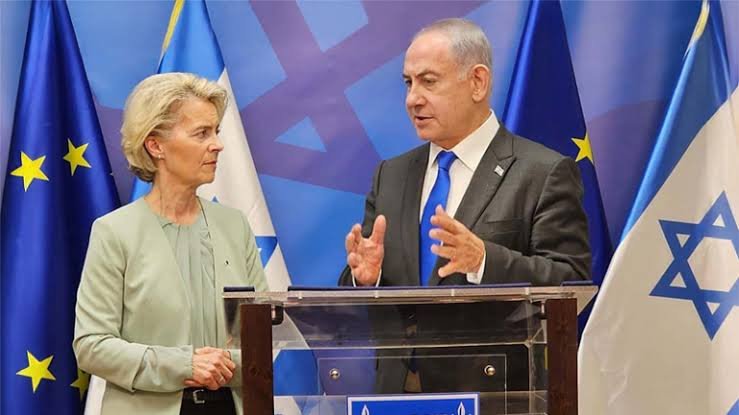
European Commission President Ursula von der Leyen has argued that the bloc cannot act effectively when its member states remain divided. During her recent state of the union address, she warned that Europe cannot change the course of events when it is unable to present a united position.
The commission previously proposed suspending preferential trade arrangements with Israel, but the initiative failed to secure sufficient support among member states. Supporters of stronger measures nevertheless argue that the commission could influence the political debate simply by formally presenting a proposal.
The dispute is becoming more striking because public opinion in some of the countries opposing stronger action appears to be moving in the opposite direction. Surveys have shown substantial majorities in Italy and Germany expressing a lack of confidence in Netanyahu’s ability to handle international affairs.
Across Europe, negative views of Israel have also increased. The shift has been particularly notable in countries including Poland, Italy and Germany, where unfavourable views rose significantly compared with the previous year.
The humanitarian situation in Gaza remains central to that public reaction. Tens of thousands of Palestinians have been killed since Israel launched its war following the Hamas attacks of 7 October 2023, while Gaza continues to face severe shortages of water, food, medicine and other essential supplies. The conflict has also caused extensive destruction, economic collapse and a continuing threat of death and injury for civilians.
Israel continues to face international criticism over military operations in Gaza and settlement policies in the West Bank. At the same time, the scale of Hamas’s attacks and the killing and hostage-taking of Israeli civilians remain central to Israel’s justification for its military campaign.
The complexity of the conflict has also created political difficulties for European movements supporting Palestinian rights. In Britain, a recent decision by the Green Party of England and Wales to adopt a motion equating Zionism with racism triggered significant criticism, including from Jewish members of the party and European Green political figures.
Critics of the motion argued that such language could undermine legitimate pro-Palestinian activism by giving opponents material to portray the wider movement as hostile to Israel or antisemitic. European Greens stressed the importance of maintaining a clear distinction between criticism of Israeli government policy and prejudice against Jewish people.
The debate illustrates how difficult the Israel-Palestine issue has become for European politics. Governments are under pressure from voters demanding stronger action over Palestinian suffering, while also facing historical, diplomatic and security considerations that make direct confrontation with Israel politically difficult.
For the EU, the central problem is therefore not a lack of awareness but an inability to translate growing concern into a unified policy. The bloc possesses substantial economic influence through its trade relationship with Israel, yet member-state divisions have repeatedly prevented that leverage from being used collectively.
The approaching Israeli election and expected Palestinian legislative vote could add further urgency to the debate. European governments will have to decide whether continued caution is sustainable as criticism from voters, diplomats, lawyers and former EU officials continues to grow.

The coming foreign ministers’ meeting may again expose the familiar divisions rather than produce a breakthrough. Yet the political environment surrounding the EU’s Israel policy is changing rapidly. Public opinion is becoming more critical, former officials are demanding action and several governments are openly questioning Israeli policies.
Whether that pressure is sufficient to overcome the bloc’s internal divisions remains uncertain. For now, the EU risks appearing increasingly disconnected from the concerns expressed by many of its own citizens, while its inability to reach a common position limits its influence over one of the most consequential and divisive conflicts surrounding Europe.
Related News:
 UN expert urges UK to rethink Israel policy
 Former ICC prosecutor condemns US sanctions
 Irish Gangland Figure Fails in Dublin Election Bid
 Israeli Strike in Southern Lebanon Kills Seven
 Ukraine Villagers Demand Answers After Deadly Arms Depot Strike
 Miliband Rejects Chief Rabbi’s West Bank Warning
 Israel Accused of Undermining Palestinian Life
 Saudi Pact Raises Risk of Pakistan Entering War
 Japan PM Backs International Criminal Court
 King Refers Jamaica Slavery Petition to Privy Council
 French Student Protests Escalate Into Violent Clashes
 Russia Escalates Ukraine Energy Attacks as Winter Nears
 French School Protests Escalate as 400 Schools Close
 Latin America women fear rollback of rights
 Israel Promotes Film Challenging Controversial Gaza Documentary
 Files Link Andrew to Epstein Dinner After Prison Release
 Emails Show Epstein Funded Mandelson’s Husband After Jail
 Hungary election: Orbán faces biggest test amid scandal
 Cartel crackdown raises fears of fresh violence
 Judge halts deportation of Yemeni refugees in US
 Activists allege abuse after Gaza flotilla seizure
 Asylum deal sparks fears over Syria deportations
 Ceasefire Standoff Deepens in Ukraine War
 Trump Announces 3-Day Russia–Ukraine Ceasefire Deal
 Putin Declares Russia Victory at Scaled Victory Day Parade
 US judge dismisses Kilmar Abrego Garcia indictment
 China mine blast death toll rises to 90
 Ebola outbreak in DRC overwhelms health system as cases surge
 Gunman Killed After White House Security Shootout
 New Footage Revives Peter Falconio Mystery
 Ukraine Creates Long-Range Strike Command
 Dreyfus Statue Finally Gets Permanent Paris Home
 Taliban global ties grow as rights fears mount
 Russian Missiles Intensify Pressure on Kyiv
 US immigration arrests hit record high in July
 Argentina Orders Return of Nazi-Looted Painting
 Sweden Election Hangs on Far-Right Breakthrough
 Texas Transfers Raise Fears for Migrant Children
 Paris child pickpocketing gang leader jailed for eight years
 Russia Targets Ukraine’s Digital Economy With Strikes
 New Maps Reveal Gaza’s Vast Destruction
 Ukraine’s New FP-7 Missile Makes Combat Debut
 Germany Pledges €1bn Military Aid to Ukraine
 Ukraine claims strikes have crippled Russia’s oil refining
 Iran Nobel Laureate Reveals Prison Torture and Fears
 Lithuania Offers to Fund Permanent US Military Base
 Former German Intelligence Chief Arrested Over Espionage
 France Braces for Major Student Protest Mobilisation
 Israeli Settlers Assault Palestinian Photographer
 Tanker Ablaze After Drone Strike Near Sochi
 France Suspends Stun Grenades After Student Injury
 Tanker Attacked Near Qatar as Hormuz Tensions Escalate
 France Promises 3,000 Teachers as Student Protests Grow
 French Taxi Driver Cleared in David Lammy Theft Case After Fare Dispute
 Greene Pushes Epstein Files Amid Trump Fallout
 Trump Deploys DHS to Charlotte in Major Arrest Operation
 Venezuela Threatens Nobel Winner Machado with Fugitive Status
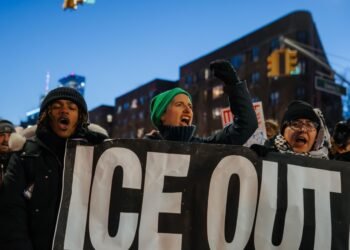 Thousands Protest ICE Operations in Nationwide US Day of Action
 Italian Town Buys Mussolini Villa to Keep Away Fascist Fans
 Ben Roberts-Smith Denies War Crime Allegations in First Statement
 Houthis Strike Saudi Arabia as Middle East Tensions Rise
 Bayeux Tapestry Revives Franco-British Ties
 Abusive ex used Tesla to control and harass former partner
 Royal Crown Branded Enslaved Africans in Britain’s Slave Trade
 Mahmood Warns Far Right Over Asylum Protests
 Harrods Faces Dispute Over Fayed Abuse Compensation
 British Columbia Sues OpenAI Over School Shooting
 US Networks Suspend Trump White House Pool Coverage
 Democrat Says ICE Restricted Detention Camp Oversight
 Republican Senator Questions Trump Ad Spending
 Madrid Tent Camp Grows as Spain Housing Crisis Deepens
 Yemen government launches offensive against Houthis
 Gosport Protesters Clash With Police Over Migrant Rescue
 Palace Rejects Funding Andrew’s Police Legal Challenge
 France Schools Protests Draw 250,000 as Police Clash
 Christa Pike Awake After Failed Tennessee Execution
 Israel Marks Three Years Since October 7 Attack
 Trump Says He Deserves Nobel Peace Prize
 South Africa Withdraws Directive on Asylum Applications
 Trump Rules Out Iran Attack Before US Elections