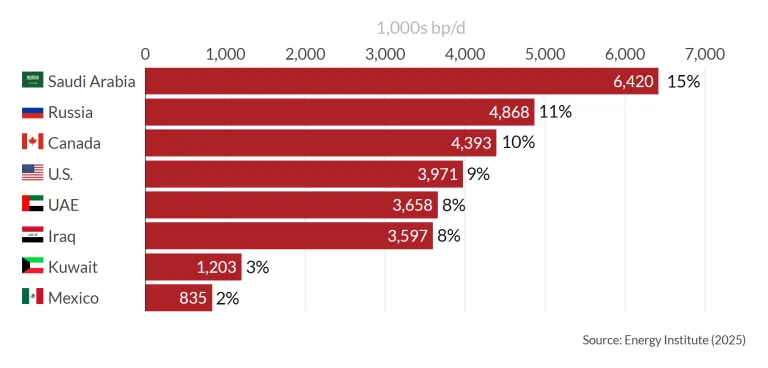
Russia, Saudi Arabia and Australia have been identified as the world’s three largest exporters of carbon dioxide emissions generated from fossil fuels over the past 175 years, according to a major historical analysis examining international coal, oil and gas exports dating back to 1850. The findings have brought renewed attention to the responsibilities of fossil fuel-producing countries in addressing climate change, particularly as international leaders gather in Turkey for the 31st United Nations Climate Change Conference, known as COP31. The analysis raises important questions about who should bear the financial responsibility for global warming, especially when fossil fuels extracted in one country are consumed in another.
The research, conducted by climate analysis organisation Carbon Brief and reviewed by the Guardian, uses a different approach from most conventional assessments of historical greenhouse gas emissions. Instead of attributing carbon dioxide emissions to the countries where fossil fuels are ultimately burned, it calculates responsibility according to the countries where coal, oil and natural gas were originally extracted and subsequently exported. By examining the historical origins of fossil fuels, the research provides a different perspective on the contribution of major energy-producing nations to the climate crisis.

Russia occupies the leading position in the historical fossil fuel export rankings. Its extensive reserves of coal, oil and natural gas have made it one of the world’s most important energy suppliers for generations. According to the analysis, fossil fuels exported from Russia have generated more than 70 gigatonnes of carbon dioxide when burned, covering the period from 1850 through the end of 2025. The figure highlights the enormous influence of Russia’s energy industry on the development of the global economy and the accumulation of greenhouse gases in the atmosphere.
Saudi Arabia ranks second, with approximately 60 gigatonnes of carbon dioxide associated with the burning of its exported fossil fuels. The kingdom has developed one of the world’s most influential oil and gas industries and remains a central player in international energy markets. Its production decisions and negotiating positions have also attracted considerable attention during international climate discussions, particularly over proposals to reduce dependence on fossil fuels and accelerate the transition towards renewable energy.
Australia occupies third place, although its estimated historical contribution through fossil fuel exports is substantially lower than those of Russia and Saudi Arabia. The country is responsible for more than 25 gigatonnes of exported carbon dioxide, placing it slightly ahead of Venezuela. The findings have generated particular interest because Australia is serving as president of this year’s COP31 climate summit in Turkey, where governments are discussing ways to reduce global emissions and strengthen financial support for countries affected by climate change.
Australia’s position presents a significant challenge for its international climate leadership. Fossil fuels account for approximately two-fifths of the country’s export economy, making coal and natural gas particularly important to national revenue and commercial activity. Despite its prominent role in international climate negotiations, Australia has not established a definitive endpoint for the extraction and export of fossil fuels.
The findings have prompted environmental campaigners to question whether countries that have accumulated substantial wealth through fossil fuel exports should accept greater responsibility for financing climate action. Louise Hutchins, convener of the Make Polluters Pay International Coalition, said the analysis exposed important contradictions within the international climate negotiation process.
She argued that governments frequently claim insufficient financial resources are available to address the climate crisis, while countries that have generated enormous wealth from fossil fuel exports continue to exercise considerable political influence. Hutchins specifically highlighted Australia’s position, suggesting that its contribution to global warming becomes more than twice as large when emissions associated with exported fossil fuels are included.
According to Hutchins, the situation raises questions about the fairness of international climate finance negotiations. Countries experiencing severe consequences from rising temperatures, extreme weather and environmental degradation are frequently among those with the least financial capacity to respond. Meanwhile, wealthy fossil fuel-producing nations have accumulated significant economic benefits from the international energy trade.
She maintained that countries and industries that have benefited financially from fossil fuel production should contribute more substantially towards addressing the environmental damage associated with climate change. Her comments reflect a growing international campaign demanding that major polluters provide financial support to vulnerable nations dealing with the consequences of global warming.
However, the analysis also highlights important differences between the responsibilities of fossil fuel producers and those of countries that consume large quantities of energy. Under conventional emissions calculations, the United States and China remain the world’s two largest historical greenhouse gas contributors. Both countries have burned enormous quantities of fossil fuels extracted domestically and imported from other nations.
Consequently, although Russia, Saudi Arabia and Australia dominate the historical export rankings, the United States and China still carry greater responsibility for total historical emissions under conventional territorial accounting. The distinction demonstrates why determining responsibility for climate change is complicated. Producers supply the fuels, international companies transport and trade them, and consumers ultimately burn them to generate electricity, operate industries, power vehicles and support economic activity.
The debate over responsibility has become increasingly important at COP31, where governments are attempting to reach agreements on the future of fossil fuels and the financial resources required to support the global energy transition.
At the COP28 conference in Dubai in 2023, participating countries agreed on the need to contribute towards transitioning away from fossil fuels in energy systems. However, the agreement did not establish a detailed timetable or comprehensive implementation programme. Since then, disagreements have continued over how quickly countries should reduce fossil fuel production and which nations should bear the economic costs of the transition.
At COP31, Australia issued an initial draft of a potential summit outcome on Monday. The proposed text included a call for the immediate transition away from fossil fuels in energy systems. The language was considered significant because it placed renewed emphasis on reducing dependence on coal, oil and natural gas.
Nevertheless, the proposal faces considerable opposition. Several countries, including Saudi Arabia, have adopted increasingly firm negotiating positions since the Dubai conference. The absence of the United States under President Donald Trump has also reduced pressure on some governments to reach compromises on contentious climate issues.
Observers have warned that the proposed reference to an immediate transition away from fossil fuels could be weakened or removed during subsequent negotiations. Saudi Arabia, Russia and several countries associated with the Arab negotiating group are also opposing the idea of adopting a comprehensive cover text for the summit, potentially creating further complications for the negotiating process.
Separate research published by Climate Analytics has raised additional questions about Australia’s domestic climate commitments. The analysis suggests that despite its prominent position at COP31, the Australian government has not developed convincing plans to significantly reduce its own fossil fuel extraction.
According to the research, coalmines are still receiving approval for operations that could continue until 2088. Such projects would remain active decades beyond the period when countries are expected to achieve net-zero greenhouse gas emissions, generally around the middle of this century.
Bill Hare, chief executive of Climate Analytics, criticised the apparent contradiction between Australia’s international climate ambitions and its domestic energy policies. He argued that approving coalmines and gasfields capable of sustaining production for decades undermines the country’s claims that it is taking sufficient action against climate change.
The political situation in Australia also complicates the government’s ability to introduce more ambitious environmental policies. Prime Minister Anthony Albanese attended COP31 last week, but faces growing domestic pressure from the One Nation party, which has gained political support and strongly opposes net-zero commitments while rejecting established climate science.
The Australian government therefore faces a difficult balancing act between maintaining its international climate leadership, protecting an economically important export industry and responding to domestic political opposition. Any major decision to restrict fossil fuel extraction could have consequences for employment, regional economies, investment and government revenue.
Saudi Arabia has also challenged the interpretation that exporting countries should be held responsible for emissions generated when their products are consumed overseas. A representative of the Saudi energy ministry said the kingdom accounted for approximately 1% of historical global carbon dioxide emissions generated within its borders.
The representative argued that Saudi Arabia exports oil to meet the energy requirements of countries around the world. According to the ministry, importing countries determine how the oil is used, which technologies are employed and how the resulting emissions are managed. The spokesperson therefore described it as misleading to attribute the emissions entirely to producing countries while overlooking the responsibilities of consumers.
Saudi Arabia also maintained that it was taking steps to reduce emissions associated with energy production. The ministry referred to peer-reviewed research published in the journal Science that identified Saudi crude oil as having comparatively low upstream carbon intensity. It also cited International Energy Agency data indicating relatively low methane intensity in Saudi oil and gas operations.
Australia and Russia were approached for comment regarding the historical export analysis.
Environmental organisations, meanwhile, have called for stronger international commitments to phase out fossil fuels and provide adequate financial assistance to vulnerable countries. Asad Rehman, chief executive of Friends of the Earth, said the long-standing relationship between fossil fuel producers and economies dependent on oil and gas needed to change. He argued that richer nations should commit to a fair and properly funded transition, including public financing and access to technologies that would enable developing countries to move towards cleaner energy systems.
The debate is particularly important for developing countries that face increasing climate-related risks despite having contributed relatively little to historical global emissions. Rising sea levels, severe flooding, prolonged droughts, extreme temperatures and increasingly unpredictable weather patterns threaten livelihoods, infrastructure and food security in many vulnerable regions. These countries frequently lack the financial resources necessary to invest in climate adaptation and disaster protection.
The historical export analysis adds another dimension to discussions about climate justice by demonstrating that the environmental consequences of fossil fuel consumption cannot be understood solely through national emissions inventories. It also raises difficult questions about the distribution of economic benefits and environmental costs across international markets.

As COP31 negotiations continue in Turkey, the disagreement between fossil fuel-producing nations, major energy consumers and climate-vulnerable countries is likely to remain one of the central challenges facing international climate diplomacy. Whether governments can agree on meaningful financial commitments and a credible timetable for reducing fossil fuel dependence will determine how effectively the summit addresses the growing climate crisis.
Ultimately, the findings place renewed pressure on wealthy energy-producing countries to explain how they intend to reconcile decades of fossil fuel exports with global climate objectives. At the same time, major consuming economies cannot avoid their own responsibilities for emissions generated through industrial activity and energy use. Achieving a fair transition will require cooperation between producers and consumers, substantial financial investment and a willingness to move beyond political disagreements towards practical climate action.
Related News:
 Capitalism ‘Suicidal’, Warns Petro at Climate Summit
 Trump announces major US oil deal with Venezuela
 Argentina Protesters Resist Milei’s Land Sale Drive
 Drax Datacentre Faces Major Carbon Emissions Concerns
 Australia Rejects Russian Fuel as Trump Strikes Deal
 UN Warns World Must Cut Emissions by 18% by 2030
 Gulf States Push Multi-Part Deal to Avert US-Iran War
 Paris Climate Agreement Faces a Critical Test After 10 Years
 The Truth Behind Rising Energy Costs and Fossil Fuel Myths
 Trump to Deploy “God Squad” Over Gulf Wildlife Protections
 Queensland Braces for Potential Second Severe Cyclone Hit
 Tragic End to Outback Search as Floods Claim a Life
 Ukraine Urges UK to Seize Russian Oil Tankers
 US Calls Australia Media Law “Foreign Extortion”
 Oil Prices Surge Above $120 Amid Iran Blockade Fears
 Ukraine strikes Tuapse as oil disaster worsens
 Norway Doubles Down on Oil and Gas for Europe Energy Security
 UN Faces Crucial Vote on Landmark ICJ Climate Ruling
 Japan Suffers Plastic Shortage Due to Middle East Crisis
 Wildfires rage across Europe as hundreds arrested in France
 Battery Fires Cost UK Recycling Industry £1bn
 Turkmenistan Begins Fixing Major Methane Mega-Leaks
 UN Warns Record El Niño Could Supercharge Global Heat
 Trump Hardens Canada Trade Stance as Talks Stall
 Swedish Mining Push Puts Sami Land Rights Under Pressure
 Nepal seeks $20m climate compensation after deadly floods
 Saudi Arabia Shuts Oil Pipeline After Drone Attack
 Europe Faces Climate Reckoning After Extreme Summer
 Super El Niño Threatens Hundreds of Thousands of Lives
 Norfolk Broads Housing Levy Faces Environmental Criticism
 Nepal PM calls deadly flood a global climate warning
 Iran Awaits Trump Response on Seven-Day Hormuz Plan
 Thai downpours shift north-westwards after Bangkok floods
 UN Warns of Narrowing Window to Restore Forests
 Swiss Glaciers Lose Nearly One-Fifth of Ice in Five Years
 UK Diesel Reaches £2 as Inflation Surges Across Europe
 Minister Rejects Fears of UK Diesel Shortage
 Bangkok Floods Push City to Breaking Point
 North Sea Strike Threatens UK Fuel Supplies
 New Zealand Faces Rising Climate Threats as Glaciers Shrink
 Norway Fjord Faces Fresh Mine Waste Dumping
 Oil Shock Sends Markets Lower as Middle East Risks Grow
 Panama Hit by Powerful 7.7-Magnitude Earthquake
 Hanson Attacks Taylor as Australian Conservatives Clash
 UK Urges Interpol to Reject Argentina’s Falklands Arrest Requests
 Serbia Leader Linked to Controversial Trump Tower Plan
 Japan’s Takaichi Faces a Crucial Second Year in Power
 Magnitude-7 Earthquake Strikes Tibet, Killing at Least 16
 US Strikes Iran Island as Vance Signals Hope for Peace
 Denmark Seeks EU-Wide Ban on Fast-Growing Turbo Chickens
 Warming UK Seas Threaten Marine Life and Food Security
 Zelenskyy Seeks Urgent Help as Russia Hits Ukraine’s Power Grid
 New Zealand’s Opportunity Party Challenges Populist Politics
 Democrats Bring New Hope to Global Climate Talks
 Labor Minister Defends Chalmers Amid Budget Tensions
 Britain Seeks Emergency Power as Wind Generation Falls
 World Faces Irreversible Climate Overshoot, Report Warns
 Indonesia Wildfires Fueled by El Niño and Climate Change
 UN Climate Talks Renew Push for Carbon Removal Technology
 ‘Extinct’ Antelope Returns to Sahara, Bringing Hope
 Extreme Weather: Europe Shivers as Cyclone Narelle Hits
 US and Iran Agree to Two-Week Provisional Ceasefire
 High Stakes in Beijing as Trump and Xi Meet Amid Global Turmoil
 Fear and Betrayal: The Chilling Case of Kouri Richins
 Trump and Xi Convene in Beijing for Historic High-Stakes Summit
 Gas Prices Fall Below $4 Following US-Iran Peace Deal
 Grief and Devotion Amidst the Rubble of Nabatieh
 Canada Secure Historic Last 16 Spot with Late Goal
 EU Slashes Steel Quotas But Grants UK Favourable Rates
 Southern Europe Reels as Wildfires Force Mass Evacuations
 Olympus Awaits Unesco Heritage Recognition
 Powerful 7.7-Magnitude Earthquake Hits Eastern Indonesia
 North Sea Firms Urge Early End to Windfall Tax
 Heathrow Expansion Faces New Climate Conditions Over CO₂
 Trump gives Xi red-carpet welcome as trade truce extends
 Poland Pushes Energy Security Beyond Russian Gas
 South Korea Probes Fuel Shipments to Russia
 Trump’s Russian Diesel Deal Sparks Ukraine Fury
 UK Land Registry Plan Faces Opposition From Landowners
 US Treasury Chief Moves to Military Base Over Iran Threat