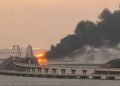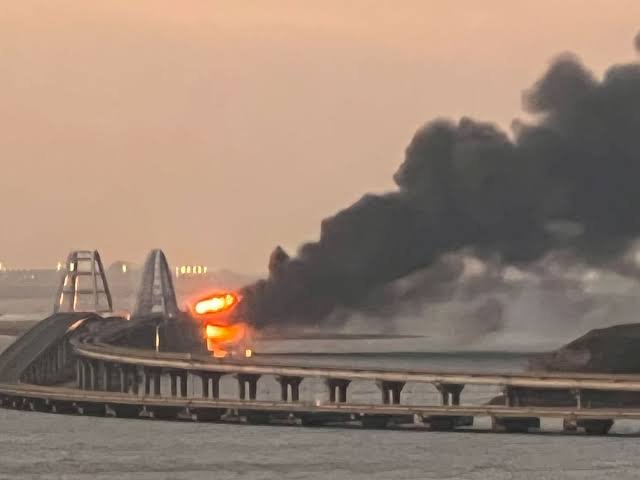
Ukraine has inflicted what could become one of the most significant blows to Russia’s military and logistical infrastructure since the beginning of the full-scale invasion, after a missile attack severely damaged the Kerch Bridge connecting Russian territory with occupied Crimea. Images and video footage emerging after the overnight assault suggest that a massive steel road arch has collapsed into the Kerch Strait, while the neighbouring railway structure has also suffered damage. The incident represents a major symbolic and strategic setback for Moscow, as the bridge has long served as a critical transport route linking Russia with the Crimean peninsula, which it annexed in 2014.
Footage circulating after the attack showed a Ukrainian-made Flamingo cruise missile approaching the bridge before striking the structure. A powerful explosion followed, raising questions about the extent of the damage and whether the crossing could be restored within a reasonable period. Ukrainian officials have described the operation as a significant achievement, while photographs taken after the explosion indicate that a substantial section of the bridge may have fallen into the water below.

The Kerch Bridge, officially known as the Crimean Bridge, was constructed following Russia’s annexation of Crimea in 2014 and opened as a major infrastructure connection between the peninsula and mainland Russia. For Russian President Vladimir Putin, the project represented an important political and economic statement, demonstrating Moscow’s determination to maintain control over the occupied territory. For Ukraine, however, the structure has always represented an extension of Russia’s occupation and a crucial military supply route supporting its operations in Crimea and southern Ukraine.
The latest attack follows years of Ukrainian efforts to weaken or destroy the crossing. In October 2022, a massive truck explosion damaged the bridge, causing significant structural damage and disrupting traffic. In July 2023, another Ukrainian operation involving maritime drones targeted the structure, damaging sections of the roadway. Although Russia subsequently carried out repair work and strengthened security around the bridge, Ukraine continued developing military capabilities designed to challenge its defensive systems.
The latest assault appears to have achieved particularly serious results. Photographs examined after the explosion suggest that the 227-metre road arch spanning the water has fallen into the Kerch Strait. The neighbouring railway arch has also reportedly sustained damage, raising concerns about the possibility of restoring both road and rail connections. Ukrainian commentators have argued that replacing such a large steel structure would be an extremely complicated engineering undertaking, potentially requiring considerable time, resources and specialised equipment.
The Russian authorities have acknowledged the latest attack and confirmed that traffic across the bridge has been suspended. Sergey Aksyonov, the Kremlin-appointed head of Crimea, announced that the crossing had once again come under attack and that movement had been halted. He urged residents and visitors to avoid travelling towards the bridge and to consider the restrictions when planning their journeys. His announcement followed an earlier temporary closure on Monday, when Ukrainian forces reportedly targeted another section of the structure.
The suspension of traffic could create substantial difficulties for Russian military logistics and civilian transportation. The bridge has served as one of the principal connections between Russia and Crimea, allowing vehicles, passengers, fuel and military supplies to move between the mainland and the peninsula. Its disruption means that transportation from Crimea towards Russian-controlled territory will increasingly depend on alternative routes, particularly the land corridor passing through occupied southern Ukraine.
That alternative route is also exposed to Ukrainian military operations. Ukrainian forces have increasingly used drones and other precision weapons to target Russian military infrastructure, supply facilities and transportation networks in occupied territories. Consequently, maintaining uninterrupted movement along the land corridor could become more difficult if Ukrainian forces continue attacking important logistical points.
The damage may also affect maritime transportation through the Kerch Strait, an important waterway connecting the Sea of Azov with the Black Sea. According to available information, debris from the collapsed structure appears to have obstructed the principal navigable channel beneath the bridge. The passage is approximately 120 metres wide and 8.3 metres deep, making it an important route for commercial and other maritime traffic serving ports in the region, including Berdiansk and Mariupol.
Submerged steel components could create additional obstacles for vessels attempting to pass through the strait. Until damaged sections and debris are removed, the movement of larger ships may face significant restrictions. Any prolonged disruption could affect regional shipping activities, although the full economic consequences will depend on the extent of the obstruction and how quickly Russian authorities can restore navigational access.
For Ukraine, the destruction or prolonged closure of the bridge carries considerable symbolic importance. Ukrainian military observers have welcomed the apparent damage, describing it as a major setback for Russia’s ability to maintain its presence in Crimea. Serhii Sternenko, a former adviser to Ukraine’s defence ministry, expressed his reaction publicly, suggesting that the bridge had suffered devastating damage. Ukrainian commentators have also warned that further attacks could target repair operations if Russian authorities attempt to restore the crossing.
While Ukraine celebrated the apparent success of the operation, Russia launched a series of retaliatory attacks against Ukrainian infrastructure. Late on Monday, Russian forces reportedly struck two major bridges crossing the Dnipro River in Kyiv. The attacks raised concerns about the vulnerability of essential transport infrastructure in the Ukrainian capital, where bridges play an important role in connecting communities on opposite sides of the river.
Kyiv Mayor Vitali Klitschko confirmed that preliminary information indicated strikes had hit bridges in the northern and southern parts of the capital. He subsequently reported water and electricity disruptions in some areas of the city. The incidents added to growing concerns about the security of essential public services as Russian forces continued their campaign against Ukrainian infrastructure.
Russian attacks also affected other parts of Ukraine. Local authorities reported that a Russian missile strike in the Cherkasy region injured three people. The northeastern city of Kharkiv, Ukraine’s second-largest urban centre, was also targeted. The latest incidents followed a series of Russian attacks on bridges crossing the Dnipro River earlier in November and October, suggesting continued efforts to disrupt transportation and logistical networks.
Russia’s defence ministry said on Tuesday that its forces had carried out a large-scale overnight operation targeting Ukrainian military-industrial facilities and transportation infrastructure. According to the ministry, the attacks affected locations in Kyiv, Zaporizhzhia, Cherkasy and Dnipropetrovsk regions. It also claimed that energy facilities, port infrastructure and vessels allegedly used by Ukraine’s armed forces had been targeted.
The claims from both sides highlight the growing importance of infrastructure in the conflict. Bridges, railways, ports and energy installations have increasingly become central targets as both countries attempt to weaken their opponent’s military supply networks and operational capabilities. The destruction of major transport links can affect not only military movements but also civilian travel, commercial activities and the delivery of essential goods.
Ukrainian President Volodymyr Zelenskyy had previously warned that intelligence information indicated Russia was preparing further attacks for Monday evening and throughout Tuesday. The warning came amid an increasingly intense exchange of missile and drone operations. Russian defence ministry figures published on Monday also indicated that Ukraine had carried out its largest overnight drone barrage since the beginning of the full-scale invasion in February 2022, although the precise operational consequences of the attacks remain contested.
Alongside the military escalation, diplomatic efforts to end the conflict have continued. Zelenskyy confirmed on Monday that Ukraine had held further online discussions with representatives of the United States and European partners regarding possible ways to bring the war to an end. The discussions reportedly involved US presidential envoys Steve Witkoff and Jared Kushner, as well as European representatives.
Kushner indicated that progress had been made towards a possible agreement, although significant challenges remained unresolved. The diplomatic discussions are taking place against the background of Russia’s invasion of Ukraine in February 2022 and its earlier annexation of Crimea in 2014. Despite continued international efforts, disagreements over occupied territories, security guarantees and the future political arrangement remain major obstacles to a settlement.
The latest damage to the Kerch Bridge could further complicate the military and diplomatic situation. For Moscow, the crossing is more than an ordinary transport facility; it represents a strategic connection to territory that Russia considers part of its own. For Kyiv, striking the structure demonstrates its continuing ability to challenge Russian military infrastructure in occupied areas.

Whether the bridge can be repaired quickly remains uncertain. The apparent collapse of the road arch, damage to the railway section and possible obstruction of maritime navigation could make the recovery operation particularly difficult. Meanwhile, the risk of further Ukrainian attacks may complicate any attempt to restore normal transportation.
As the war continues, the latest developments demonstrate how both countries are increasingly targeting infrastructure with strategic and economic significance. The Kerch Bridge attack could become an important moment in Ukraine’s campaign to weaken Russia’s logistical position in Crimea, while Moscow’s continuing strikes against Ukrainian cities underline the serious consequences of the conflict for civilian populations and essential services. The coming days will be crucial in determining the full extent of the damage and whether the crossing can be restored without further disruption.
Related News:
 Putin Declares Russia Victory at Scaled Victory Day Parade
 Russian Missiles Intensify Pressure on Kyiv
 Ukraine’s New FP-7 Missile Makes Combat Debut
 Zelenskyy warns over Oreshnik threat as Kyiv hit
 Russian Strikes Disrupt Kyiv Bridge Traffic
 Germany Pledges €1bn Military Aid to Ukraine
 Trump Slams Ukraine Strikes as Russia Ceasefire Collapses
 UK Prepares Aircraft Carrier for Middle East Crisis
 Trump orders US troop pullout from Germany
 Activists allege abuse after Gaza flotilla seizure
 Ukraine strikes Tuapse as oil disaster worsens
 Global order shifts amid Trump-era turmoil
 Ceasefire Standoff Deepens in Ukraine War
 Middle East Crisis Escalates as Oil Routes Shake Markets
 Discontent grows around Putin amid war strain
 Former ICC prosecutor condemns US sanctions
 Houthis Strike Saudi Arabia as Middle East Tensions Rise
 Taliban global ties grow as rights fears mount
 Trump dismisses concerns over 250-day carrier deployment
 Trump Calls Strait of Hormuz ‘American Territory’
 Trump Faces Iran War Crisis Before Midterm Vote
 UN expert urges UK to rethink Israel policy
 Netanyahu faces protests and pressure at UN
 Iran Awaits Trump Response on Seven-Day Hormuz Plan
 Russia Targets Ukraine’s Digital Economy With Strikes
 Trump Asked Xi About Buying US Weapons
 Putin Orders Russian Army Expansion as War Intensifies
 South Korea-Ukraine Row Erupts Over North Korean POWs
 South Korea demands apology over DMZ mine blast
 Russia Escalates Ukraine Energy Attacks as Winter Nears
 Ukraine claims strikes have crippled Russia’s oil refining
 Lithuania Offers to Fund Permanent US Military Base
 Canadian Veterans Condemn Trump Allies’ Military Remarks
 Israeli Settlers Assault Palestinian Photographer
 Tanker Ablaze After Drone Strike Near Sochi
 EU Divisions Deepen Over Israel Policy
 Milan Braces for Unrest as Debate Intensifies Over Lost Generation
 Ukraine Peace Talks Set to Resume in November
 Palestinian Parties Gain Power in Israel’s Election
 Gulf States Push Multi-Part Deal to Avert US-Iran War
 US Strikes Iran Island as Vance Signals Hope for Peace
 Zelenskyy Sees Peace Opportunity as US Envoys Meet Putin
 Iran unrest slows under brutal crackdown and global tensions
 Thousands Protest ICE Operations in Nationwide US Day of Action
 Epstein Files Reveal Trump Officials’ Emails with Financier
 Italian Town Buys Mussolini Villa to Keep Away Fascist Fans
 Hungary election: Orbán faces biggest test amid scandal
 Oil Prices Surge Above $120 Amid Iran Blockade Fears
 Trump Announces 3-Day Russia–Ukraine Ceasefire Deal
 Le Pen to Run for President Despite Embezzlement Conviction
 Former Diplomats Urge UK and France to Act on Palestine
 Ukraine Villagers Demand Answers After Deadly Arms Depot Strike
 Trump Hardens Canada Trade Stance as Talks Stall
 Bayeux Tapestry Revives Franco-British Ties
 Europe’s democracies face a growing far-right threat
 Sweden Election Hangs on Far-Right Breakthrough
 Madrid Tent Camp Grows as Spain Housing Crisis Deepens
 Pilot and Passengers Help Save Flydubai Flight
 New Maps Reveal Gaza’s Vast Destruction
 US Sends Third Carrier to Middle East
 French School Protests Escalate as 400 Schools Close
 Bosnia’s Young People Look Beyond Election Hope
 Yemen government launches offensive against Houthis
 Argentina Protesters Resist Milei’s Land Sale Drive
 France Schools Protests Draw 250,000 as Police Clash
 Israel Marks Three Years Since October 7 Attack
 UK Mission in East Jerusalem to Remain Open
 Israel Promotes Film Challenging Controversial Gaza Documentary
 Trump Rules Out Iran Attack Before US Elections
 French Students Protest Poor Conditions in Paris Suburbs
 Greta Thunberg Backs French Students in School Protests
 Ukrainian Soldier Faces Trial Over Nord Stream Blast
 Serbia Leader Linked to Controversial Trump Tower Plan
 Japan’s Takaichi Faces a Crucial Second Year in Power
 Spain Deepfake Ad Sparks Election Outrage
 Riot Police Deployed as Poland Court Row Escalates
 Canada Joins Boycott of Russian Ice Hockey Teams
 US Treasury Chief Moves to Military Base Over Iran Threat
 Ilse Aigner Set to Make German History as First Female President
 CEU Eyes Budapest Return as Hungary Enters New Era