Published: 05 October 2026. The English Chronicle Desk. The English Chronicle Online
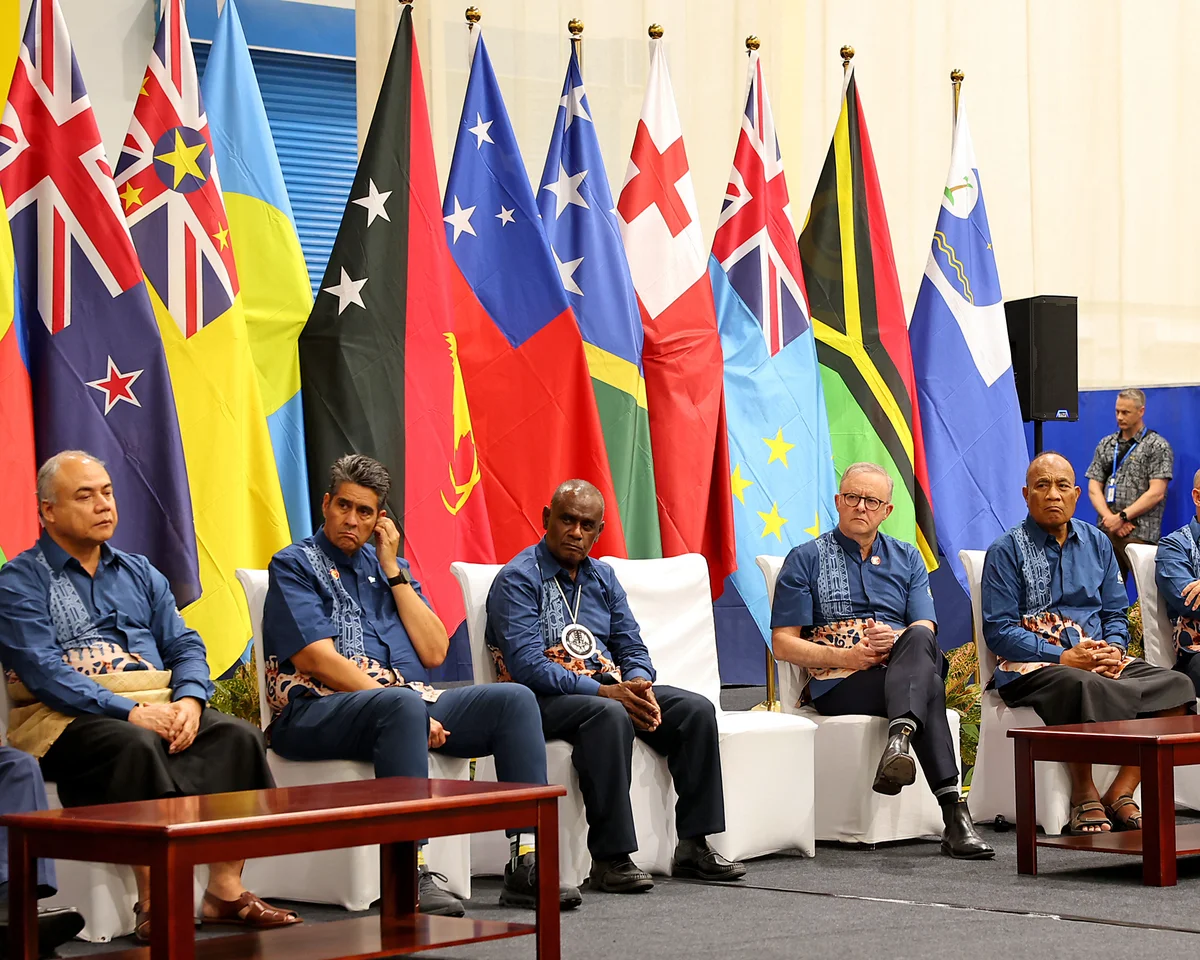
Australia’s Prime Minister Anthony Albanese has arrived in Fiji for a major preparatory meeting ahead of the United Nations climate summit, but the effort to bring wider international attention to the Pacific’s climate emergency has faced a disappointing start, with only a small number of leaders from outside the region accepting an invitation to travel to Tuvalu.
Albanese joined about 4,000 delegates, officials, activists and other participants in Nadi on Monday for the pre-COP meeting, which is intended to build momentum before the main COP31 climate negotiations scheduled to take place in Turkey later this year.
The gathering is particularly significant for Pacific nations, which have argued for years that their communities are among the first and most vulnerable to the effects of global heating. Australia and its regional partners had hoped that holding the preparatory meeting in the Pacific would give greater prominence to the concerns of island states facing rising seas, increasingly severe weather and threats to their long-term survival.

Albanese used his arrival in Fiji to emphasise the importance of ensuring that Pacific countries have a strong voice in international climate discussions. He said the region was on the frontline of climate change and that, for some island nations, the consequences represented a direct threat to their continued existence.
The Australian government had invited national leaders to travel to Tuvalu as part of the preparations. However, the response from governments outside the Pacific has been limited. The Australian government confirmed on Monday that 14 national leaders were expected to make the journey to the low-lying island nation, but only two of them, Timor-Leste’s President José Ramos-Horta and Mauritius Prime Minister Navin Ramgoolam, were travelling from beyond the Pacific region.
The relatively small number of international leaders has raised questions about whether Australia has succeeded in achieving one of its central objectives for the event: placing the climate vulnerability of Pacific nations firmly at the centre of the global political agenda.
Several factors appear to have contributed to the limited attendance. Tuvalu is geographically remote, while many world leaders are expected to prioritise the main COP31 negotiations in Antalya, Turkey, which will take place only weeks after the Fiji meeting. Geopolitical tensions and competing international priorities have also made it more difficult for governments to send senior political figures to the Pacific.
Despite the criticism, Australian officials have defended the importance of the gathering. Climate Change Minister Chris Bowen said the meeting would bring together a range of influential figures, including European Union climate commissioner Wopke Hoekstra, senior representatives of the Asian Development Bank and Green Climate Fund, United Nations climate chief Simon Stiell and Turkey’s incoming COP president Murat Kurum.
International journalists and thousands of other participants are also attending the meeting, making it considerably larger than the traditionally technical and bureaucratic pre-COP gatherings that normally precede the main climate conference.
Australia’s opposition has taken a sharply different view. Opposition energy and emissions reduction spokesperson Dan Tehan criticised the event, arguing that the limited number of national leaders travelling to Tuvalu demonstrated that the conference was an unnecessary use of public money. He described the Fiji gathering as a farce and accused Bowen of turning it into a personal political project.
The criticism comes as the Australian government faces increasing pressure over its domestic climate and energy policies. Environmental groups and political opponents have questioned Canberra’s approval of new coal and gas developments while it seeks to present itself as a regional leader on climate action.
The government has also faced calls to reject a major proposed coal development in New South Wales after the project received state approval. The controversy has intensified questions about whether Australia can credibly encourage other countries to reduce their dependence on fossil fuels while continuing to support significant coal and gas projects at home.
Bowen defended the government’s approach during discussions in Fiji, arguing that the transition away from fossil fuels would require the rapid expansion of renewable energy. He has also promoted greater electrification as part of the strategy to reduce dependence on coal, oil and gas.
The challenge facing Australia is particularly significant because of its position within the Pacific. The country is one of the region’s largest economies and a major exporter of fossil fuels, while neighbouring island states have some of the smallest contributions to global greenhouse gas emissions but face some of the most severe consequences.
For Pacific leaders, climate change is not an abstract environmental debate. Rising sea levels threaten coastal communities, saltwater intrusion can damage freshwater supplies and farmland, and stronger storms can destroy infrastructure and homes. Many island governments have repeatedly warned that their future depends on ambitious international action to limit global temperature increases.
Fiji’s Environment Minister Lynda Tabuya said the country wanted the pre-COP discussions and the eventual COP31 summit to keep the goal of limiting global warming to 1.5C within reach. She also called for faster and fairer access to climate finance for developing countries and urged governments to make ocean health a more prominent part of international climate policy.
At a welcoming event in Fiji, Prime Minister Sitiveni Rabuka delivered a broader message about the importance of listening to Pacific countries. He argued that the region should not simply be viewed as a collection of vulnerable states deserving sympathy, but rather as an early warning system for the wider consequences of climate change.
Rabuka highlighted the importance of the Pacific Ocean to global weather patterns and warned that changes in ocean temperatures could produce consequences far beyond the region. He pointed to the influence of climate phenomena such as El Niño, which can contribute to extreme weather and disrupt communities across different parts of the world.
His message reflects a growing effort by Pacific governments to shift the international climate conversation away from viewing island nations solely as victims. Instead, they want their experience of climate impacts to inform global policy and demonstrate what could happen elsewhere if warming continues.
The urgency has been reinforced by recent scientific assessments warning that the world is likely to exceed the 1.5C temperature goal established under the Paris climate agreement. Scientists and international organisations have repeatedly stressed that every additional fraction of a degree of warming increases the risks of extreme weather, ecosystem damage, glacier loss and coastal flooding.
For vulnerable Pacific nations, those warnings carry immediate consequences. Some communities are already experiencing coastal erosion, flooding and damage to traditional livelihoods, while governments face the expensive challenge of adapting infrastructure to a changing climate.
The Fiji meeting therefore carries significance beyond its attendance figures. It provides Pacific nations with a platform to press larger economies for stronger commitments before the main international negotiations begin.
For Albanese, the gathering also represents an opportunity to reinforce Australia’s diplomatic relationship with Pacific neighbours. His government has sought to strengthen engagement with island nations, recognising that climate change is closely linked to regional security, development and long-term political stability.
However, the limited participation of leaders from outside the Pacific highlights the difficulty of translating diplomatic commitments into sustained political attention. With the major COP31 negotiations approaching, Pacific governments will be watching closely to see whether the concerns raised in Fiji receive meaningful consideration in the final international agreements.

The debate will also test Australia’s credibility. Canberra wants to position itself as an important voice for Pacific climate concerns, but its continued support for fossil fuel developments provides an obvious target for critics.
As the pre-COP meeting continues, the central challenge remains clear: vulnerable countries want stronger climate action, greater financial support and a credible pathway to keep the 1.5C target alive. Whether the Fiji gathering can help turn those demands into concrete international commitments will become clearer as governments move towards the larger COP31 negotiations.
For the Pacific, the stakes could hardly be higher. The region is asking the world not simply to acknowledge its vulnerability but to recognise its warnings and act before the impacts of climate change become even more difficult and costly to reverse.
Related News:
 Venezuela Quake Death Toll Surpasses 4,000
 Five Years of Taliban Rule Leave Afghanistan in Crisis
 Nepal Flood Survivors Face Unimaginable Loss
 Nepal Tunnel Rescue Offers Hope Amid Flood Devastation
 Nepal PM calls deadly flood a global climate warning
 Nine Killed in Karachi Consulate Protest
 Moldova River Crisis Exposes War’s Hidden Cost
 Canadian astronaut French words ease language row
 Chornobyl Still at Risk 40 Years After Disaster
 Southeast Asia Turns to Russia Amid Energy Crisis
 Escobar’s Hippos May Be Moved to India Zoo
 Capitalism ‘Suicidal’, Warns Petro at Climate Summit
 China Fireworks Factory Blast Kills 21 in Hunan
 Australia pushes Pacific security pact amid China tension
 France Faces Record Presidential Crowded Race Amid Far-Right Surge
 Norway Doubles Down on Oil and Gas for Europe Energy Security
 US Awaits Iran Reply on New Ceasefire Proposal
 One Nation Stuns Australia With Historic Farrer Win
 Hormuz Talks Near Critical Stage
 Pope Meets Families in Italy Toxic Waste Zone
 Discontent grows around Putin amid war strain
 Farage and Reform UK Reshape British Politics
 Starmer Leadership Under Pressure After Setbacks
 Germany Summons Chinese Envoy Over Russian Troop Training
 Millions Gather for Khamenei’s Six-Day State Funeral
 Le Pen’s Popularity Holds Despite Conviction
 Dreyfus Statue Finally Gets Permanent Paris Home
 Olympus Awaits Unesco Heritage Recognition
 Houthis Strike Saudi Arabia as Middle East Tensions Rise
 Three-Quarters of England’s Riverbanks Still Off Limits
 Powerful 7.7-Magnitude Earthquake Hits Eastern Indonesia
 Israeli Strike in Southern Lebanon Kills Seven
 Is America Ready for an AOC Presidential Run?
 Burnham unveils £65m drought aid for farmers
 Australia Races to Find Tourists Missing in Nepal
 Nepal Flood Death Toll Tops 300 as Second Flood Feared
 Nepal-Tibet Flood Death Toll Rises as 2,478 Remain Missing
 Nepal Rescuers Race to Save Hundreds Trapped Underground
 Green Leader Targets Starmer’s Former Seat
 Masked Protesters Bring Dover Port Traffic to Standstill
 Susan Sarandon Says Palestine Stand Costs Roles
 Typhoon Saudel Triggers Mass Evacuations in China
 Nepal seeks $20m climate compensation after deadly floods
 Saudi Arabia Shuts Oil Pipeline After Drone Attack
 Nearly 50,000 Flee as Houthis Advance in Yemen
 Yemen War Displaces 125,000 as Fighting Intensifies
 South Korea Rules Out Military Role in Iran War
 Saudi Pact Raises Risk of Pakistan Entering War
 Lib Dems Prepare for Election Amid Reform Challenge
 Middle powers seek new alliances amid Trump era
 Japan Braces for Dujuan as Storm Threat Grows
 Tropics May Wait Longest for Net-Zero Climate Benefits
 Japan PM Backs International Criminal Court
 King Refers Jamaica Slavery Petition to Privy Council
 Iran Rejects Claims of Shift in US Talks
 Greece Pushes for Parthenon Marbles Reunification
 Elif Eralp Emerges as Berlin’s Next Political Force
 Xi urges Trump to avoid US-China military conflict
 Saudi intercepts Houthi missiles as oil fears grow
 Thai downpours shift north-westwards after Bangkok floods
 Three Die in Channel Crossing Attempt Near France
 Madrid Tent Camp Grows as Spain Housing Crisis Deepens
 South Korea-Ukraine Row Erupts Over North Korean POWs
 French Student Protests Escalate Into Violent Clashes
 Israel-bound Plane Lands in Saudi Arabia After Cockpit Fight
 Burnham Opens Door to Possible UK Return to EU
 Drumcree Talks Falter as Legal Challenge Deepens
 UK-France Returns Deal Faces Expiry as Talks Stall
 New Maps Reveal Gaza’s Vast Destruction
 Green Party faces dispute over Zionism motion
 Pilot Recalls Fight to Save Flydubai Passengers
 French School Protests Escalate as 400 Schools Close
 Polanski Says Leadership Not Tied to By-election Result
 Bangkok Floods Push City to Breaking Point
 North Korea Fires Missile Amid DMZ Tensions
 Families Await USS Abraham Lincoln Homecoming
 Bosnia’s Young People Look Beyond Election Hope
 Germany Pledges €1bn Military Aid to Ukraine
 Latin America women fear rollback of rights
 Spain Sets Snap Election as Housing Crisis Deepens