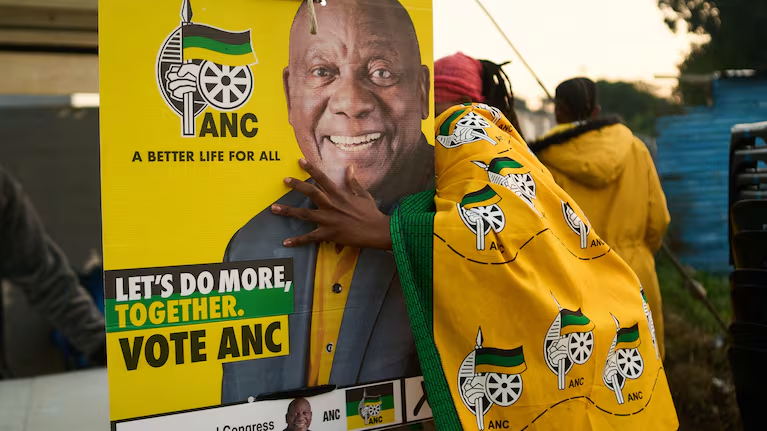
South Africa’s governing African National Congress (ANC) is facing a potentially historic setback as millions of voters head to the polls in local elections amid growing frustration over unreliable public services, deteriorating infrastructure and political instability. The party, which led the country out of apartheid and dominated national politics for three decades, is expected to secure less than a third of the vote, according to opinion polls, reflecting the scale of public dissatisfaction with its performance.
Although the ANC is still expected to emerge as the largest political party nationally, its projected support represents a dramatic decline from previous elections. The party received 45.6 per cent of the vote in the 2021 municipal elections and 40.2 per cent in the 2024 national elections. A result below 33 per cent would underline how significantly its political influence has weakened as voters increasingly question its ability to manage local authorities and deliver essential services.
The elections are taking place against a difficult backdrop for communities across South Africa. Water shortages, electricity interruptions, damaged roads, deteriorating public facilities and inadequate municipal management have become central concerns for many residents. For voters who regularly experience disruptions to basic services, the performance of local government is no longer an abstract political issue. It directly affects household routines, businesses, employment opportunities, public health and the overall quality of life.

The ANC’s electoral challenges are particularly significant because of its historical role in South Africa. Under Nelson Mandela’s leadership, the party came to power in 1994 following the end of apartheid, marking a defining moment in the country’s history. For many South Africans, the ANC remains closely associated with the struggle for democracy, equality and political freedom. However, the political loyalty built during that period has increasingly been tested by expectations that the party would translate those achievements into effective administration and improved living conditions.
The fragmentation of the political landscape could nevertheless allow the ANC to retain influence in several municipalities, even if its national vote share falls sharply. South Africa has 257 municipalities, and many already depend on coalition arrangements because no single party commands a clear majority. These alliances have frequently proved unstable, with disagreements over leadership, policy priorities and political appointments contributing to repeated changes in municipal administrations.
Analysts have identified the high turnover of coalition governments as one of the factors behind weak service delivery. When political parties struggle to maintain working relationships, municipal decision-making can become unpredictable. Disputes over budgets, administrative appointments and development priorities may delay projects and weaken the ability of local authorities to respond to residents’ needs. The result can be a cycle in which political instability and poor public services reinforce one another.
The situation is particularly visible in Gauteng, South Africa’s most populous province and a major centre of economic activity. The province includes Johannesburg, Ekurhuleni and Tshwane, three major metropolitan areas that have experienced significant political and administrative challenges. The centre-right Democratic Alliance (DA), which is led nationally by a predominantly white political leadership, is ahead in polling in all three metropolitan areas. However, it has not been projected to win more than 40 per cent of the vote in any of them, suggesting that coalition negotiations are likely to remain essential.
Johannesburg, a city of approximately 4.8 million people, has become a prominent example of the difficulties facing local government. Residents have endured water shortages lasting more than a week, adding to wider concerns about the reliability of municipal infrastructure. The city has also had 10 mayors over the past decade, a level of leadership turnover that illustrates the instability surrounding its administration.
Neighbouring Ekurhuleni has had three mayors since 2021, while Tshwane, which includes the national capital Pretoria, has seen the mayoralty change hands between political parties four times since 2020. Such frequent changes have raised questions about continuity in municipal planning and the ability of administrations to complete long-term infrastructure programmes.
Public health concerns have also intensified in parts of Tshwane. In October, more than 800 people reportedly contracted a gastrointestinal illness linked to contaminated water in Bronkhorstspruit, an area in the eastern part of the municipality. The incident has highlighted the serious consequences that can arise when water quality and public infrastructure are not adequately maintained. Reliable access to clean water is a fundamental responsibility of local government, and failures in this area can place vulnerable communities at particular risk.
The political contest in Gauteng is also complicated by disagreements within the ANC over possible coalition partners. The party’s national leadership is reportedly open to working with the DA, reflecting the cooperation between the two largest parties in South Africa’s national government of unity. However, local ANC leaders are said to be less enthusiastic about such an arrangement. At present, the ANC governs the province’s three major metropolitan areas through combinations involving the Economic Freedom Fighters, the Patriotic Alliance and ActionSA.
In Johannesburg, DA mayoral candidate Helen Zille has attracted considerable attention during her campaign. The former mayor of Cape Town has used unconventional public appearances to highlight the city’s infrastructure problems, including snorkelling in a pothole and kayaking along a flooded street. The stunts have generated widespread attention, allowing her campaign to focus on issues that residents encounter in their daily lives.
However, Zille continues to face resistance among some voters, particularly within sections of the black community. Controversial comments she made in the past, which critics interpreted as appearing to excuse aspects of colonialism, have contributed to mistrust. Her opponents have also pointed to rising housing costs in Cape Town, a city governed by the DA since 2006, arguing that the party has not adequately addressed affordability and access to housing.
ActionSA leader Herman Mashaba has added another complication to the Johannesburg contest. Mashaba, who previously served as the city’s DA mayor, is leading a party polling at around 10 per cent. He has ruled out working with Zille in the city and has described her as racist, an accusation she has consistently rejected. The disagreement makes it more difficult for the DA to assemble a coalition even if it performs strongly at the ballot box. Meanwhile, the ANC is facing internal divisions over its own possible mayoral candidates, with three individuals reportedly under consideration.
The electoral contest in Durban presents a different challenge for the governing party. In the eThekwini metropolitan area, which includes the major port city, the uMkhonto we Sizwe (MK) party led by former president Jacob Zuma is polling above 40 per cent. The party has emerged as a significant competitor to the ANC, particularly among voters who previously supported the governing movement.
Zuma, who is 84, has remained a prominent and controversial figure in South African politics. He has faced numerous corruption allegations, which he has denied. His political influence has nevertheless helped the MK party attract support, particularly in areas where dissatisfaction with the ANC is widespread.
The potential impact on the ANC is substantial. The party secured 42 per cent of the vote in eThekwini in the 2021 municipal elections, but current polling suggests its support could fall to around 10 per cent. If that projection is reflected in the final results, the loss would represent one of the most striking examples of the changing political loyalties within the ANC’s traditional support base.
In Cape Town, meanwhile, the DA is expected to retain control, although its vote share could fall below the 58 per cent it secured in 2021. Housing affordability has become a growing concern, with increasing living costs placing pressure on residents and raising questions about the city’s approach to urban development. The party’s ability to maintain its majority will therefore depend partly on whether voters believe it has responded effectively to those concerns.
The election results will not immediately determine who becomes mayor in every municipality. South African voters are choosing councillors and political parties, while mayors are elected through municipal councils after the results are announced. The country’s electoral commission is expected to have up to a week to declare the final outcome. Political parties will then have two weeks from the announcement to negotiate governing arrangements, form councils and elect mayors.

Those negotiations could prove as politically important as the voting itself. In municipalities where no party wins an outright majority, smaller parties may hold the balance of power. Their decisions about which larger party to support could determine the direction of local government for the coming years. However, repeated coalition breakdowns would risk prolonging the instability that has already affected service delivery in several major cities.
For the ANC, the elections represent more than a contest for municipal seats. They are a test of whether the party can regain public confidence after years of criticism over governance and essential services. A substantial decline in support would increase pressure on its leadership to address weaknesses in local administration and demonstrate that political renewal can produce practical improvements.
For South African voters, the immediate priority is more straightforward: dependable water supplies, electricity, functioning roads, effective municipal services and accountable local leadership. The election offers an opportunity to express dissatisfaction and influence who manages their communities. Whether the outcome produces more stable governments and better services will depend on the willingness of political parties to cooperate beyond election day.
Related News:
 Controversial Vaccine Trial Approved in Guinea-Bissau
 Is America Ready for an AOC Presidential Run?
 Five Years of Taliban Rule Leave Afghanistan in Crisis
 Lib Dems Prepare for Election Amid Reform Challenge
 UK Pauses Chagos Deal Amid US Opposition
 Elif Eralp Emerges as Berlin’s Next Political Force
 Economic growth and political strain reshape Benin
 Drumcree Talks Falter as Legal Challenge Deepens
 UK-France Returns Deal Faces Expiry as Talks Stall
 Green Party faces dispute over Zionism motion
 Latin America women fear rollback of rights
 India’s Youth Movement Alleges Mass Detentions Before Protest
 Gaza War Deepens India’s Strategic Ties With Israel
 Bolsonaro Gains Key Endorsement Ahead of Brazil Runoff
 Navi Pillay Wins Nobel Peace Prize for Justice
 Trump Attacks Norway After Nobel Peace Prize Snub
 Delhi Braces for Youth Protests Over Voter Roll Dispute
 Trump Names Katie Zacharia as Next White House Spokesperson
 UK Gaza Refugee Route Criticised Over False Hope Claims
 PTI Announces Swabi Rally Ahead of Long March Plans
 French Students Protest Poor Conditions in Paris Suburbs
 UK Greens Face Crisis Over Zionism and Extremism Row
 Greta Thunberg Backs French Students in School Protests
 Millions Face Tougher Medicaid Rules From January
 Ohio Airports Become Key Hubs for ICE Deportation Flights
 Farage Rejects Claims Reform Would Let Troops Shoot Migrants
 Gadi Eisenkot: Israel’s Anti-Netanyahu Challenger
 Nigeria Confirms Ebola Case as Regional Outbreak Spreads
 Taylor Faces Backlash Over Response to Haines Attack
 UK Aid Set to Fall Short of Reduced 2027 Target
 Serbia’s Student Victory Sparks a ‘Smell of Freedom’
 Trump’s Midterm Campaign Faces Racism and Political Backlash
 McKenzie Warns MP Safety Fears Could Weaken Democracy
 King Charles Faces Calls for Slavery Reparations Talks
 Spain Mourns 68 Dead After High-Speed Train Crash
 Obama Mocks Trump at Georgia Rally for Democrats
 UAE Nominee Faces Backlash Over Sudan War Role
 Novaya Gazeta to Close After Russian Government Pressure
King Charles Faces Reparations Protests at Antigua Summit
 Bedouin Women Drive Historic Arab Election Gains
 US ‘Narco Boat’ Strikes Draw Global Outcry
 Farage and Reform UK Reshape British Politics
 Starmer Leadership Under Pressure After Setbacks
 Le Pen’s Popularity Holds Despite Conviction
 Ghent Professors Questioned Cofnas Appointment
 RAF Barnham Protests Fuel Tensions in Norfolk Town
 Ukraine Villagers Demand Answers After Deadly Arms Depot Strike
 Trump Calls Iran War ‘Small Potatoes’ Despite US Deaths
 Europe’s democracies face a growing far-right threat
 Israel Accused of Undermining Palestinian Life
 Turkey LGBTQ Crackdown Expands With New Arrests
 US Networks Suspend Trump White House Pool Coverage
 Democrat Says ICE Restricted Detention Camp Oversight
 Tropics May Wait Longest for Net-Zero Climate Benefits
 Lula accuses Trump of seeking control over Brazil
 Republican Senator Questions Trump Ad Spending
 Free Speech Emerges as Key UK Election Issue
 Madrid Tent Camp Grows as Spain Housing Crisis Deepens
 Burnham Opens Door to Possible UK Return to EU
 Badenoch Raises Prospect of 2027 UK Election
 French School Protests Escalate as 400 Schools Close
 Families Await USS Abraham Lincoln Homecoming
 Trump Says He Deserves Nobel Peace Prize
 Israel Promotes Film Challenging Controversial Gaza Documentary
 South Africa Withdraws Directive on Asylum Applications
 Australian Advocates Seek Subsidised Drugs for PMOS
 Trump Names Katie Zachariah as Next White House Press Secretary
 Brazil Court Scandal Threatens Lula as Bolsonaros Rise
 India’s Voter Roll Crisis Sparks Nationwide Protests
 Ukrainian Soldier Faces Trial Over Nord Stream Blast
 Senegal LGBTQ+ Crackdown Drives People Into Hiding
 Serbia Leader Linked to Controversial Trump Tower Plan
 Zelenskyy Says US Failed to Warn Kyiv of Russian Strikes
 Greens Face Leadership Test as Jordon Steele-John Misconduct Claims Leave Party in Limbo
 Lula Supporters Make Final Push Ahead of Brazil Runoff
 Xi Jinping Tightens China’s Anti-Corruption Campaign
 Ukraine Peace Talks Set to Resume in November
 Trump’s Global Policies Put Republicans at Risk
 Alan Jones Trial Paused for Melbourne Cup Viewing
 Canada Joins Boycott of Russian Ice Hockey Teams